
Are weighted blankets safe for kids? They are never appropriate for infant sleep, and there is no universal age or body-weight formula that makes one automatically safe for an older child. For a school-age child, consider one only after reviewing the child’s health, mobility, understanding, ability to remove it independently, product design, manufacturer instructions, and recall status. Never use a weighted blanket as restraint, never cover the head or neck, and remove it immediately for breathing difficulty, overheating, pain, panic, numbness, or restricted movement.
The old advice that a weighted blanket becomes safe at age three or when it equals a fixed percentage of body weight is too simple. Safety depends on the individual child and the exact product. A blanket with a zippered cover, weak stitching, an oversized shape, or a design the child can crawl inside may create hazards even when its listed weight appears modest.
Infants and infant sleep products
No weighted blankets, swaddles, sleepers, sleep sacks, clothing, or weighted objects should be used on or near a sleeping infant.
Medical, developmental, or mobility concerns
Ask the child’s clinician or occupational therapist when breathing, circulation, sensation, movement, medication, or understanding may affect safe removal.
Older child who can remove it easily
Use only a product designed for the child’s size, follow its instructions, begin while awake, supervise, and stop at the first sign of discomfort.
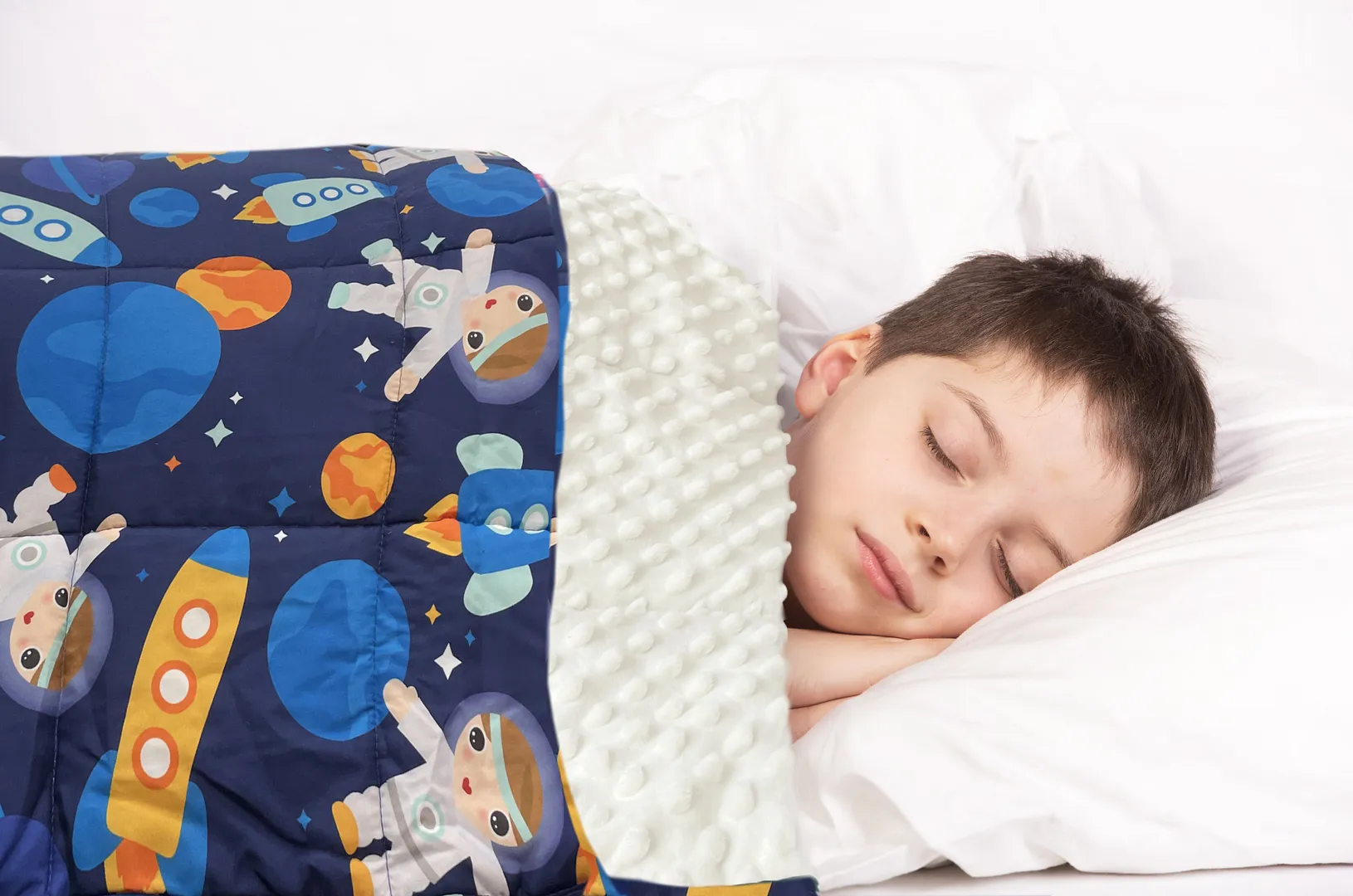
Weighted Blankets Are Not Safe for Infant Sleep
Weighted blankets and weighted clothing do not belong in an infant sleep space.
The American Academy of Pediatrics recommends that weighted blankets, weighted sleepers, weighted swaddles, and other weighted objects not be placed on or near a sleeping infant. A firm, flat sleep surface with a fitted sheet and no loose bedding is the safer setup.
HealthyChildren, the AAP’s parent education site, likewise says not to use weighted blankets or weighted clothing for babies. For warmth, properly fitted non-weighted sleep clothing or a regular wearable blanket may be used according to safe-sleep guidance. See the current AAP parent guidance.
Product advertising, social-media testimonials, and claims of longer sleep do not override pediatric safe-sleep recommendations.
Are Weighted Blankets Safe for Kids Beyond Infancy?
There is no single U.S. pediatric rule saying that every child becomes eligible at age three, five, or another fixed birthday. For children beyond infancy, the decision should be individualized and conservative. The child should understand the blanket, want to use it, remain able to move, and remove it without assistance.
Can the child stay in control?
Consider age, strength, coordination, communication, judgment, sensory response, temperature regulation, breathing, circulation, skin sensation, medication effects, and ability to wake and remove the blanket.
Can the blanket create entrapment?
Inspect the size, fill, seams, ties, loops, zippers, removable covers, pockets, openings, loose components, warning labels, age range, and whether it hangs over the bed.
Somerset NHS Foundation Trust’s children’s therapy guidance says its service does not recommend weighted blankets as therapy because evidence is limited. Where families nevertheless use one, it advises supervision, independent removal, uncovered head and neck, no restraint or rolling, manufacturer sizing, and immediate removal for breathing difficulty, overheating, nausea, anxiety, or discomfort. It also advises removing the blanket once the child is asleep rather than leaving it on overnight. Review the current NHS guidance.
Eight Checks Before a Child Uses a Weighted Blanket
- Confirm the child is not an infant. Weighted sleep products are not appropriate for infant sleep.
- Ask why the blanket is being considered. Comfort or a short sensory trial is different from attempting to treat insomnia, autism, ADHD, anxiety, or another condition.
- Review health and medication. Seek professional advice when breathing, circulation, mobility, muscle tone, sensation, temperature control, seizures, sedation, recent surgery, or other medical issues may affect use.
- Test independent removal. While fully awake, the child should be able to push the blanket away, uncover themselves, sit up, and leave without coaching or help.
- Inspect product construction. Avoid designs the child can enter, become enclosed within, or trap the head, neck, or limbs inside.
- Check recall status. Search the exact brand, model, item number, and date code before first use and periodically afterward.
- Begin with a short awake trial. Place it loosely over the body, keep the face and neck clear, supervise continuously, and do not tuck, wrap, fasten, or roll the child inside.
- Define stop conditions in advance. Remove it for heat, sweating, breathing changes, pain, numbness, tingling, panic, nausea, unusual drowsiness, skin marks, or difficulty moving.
Is the “10% of Body Weight” Rule Reliable?
The 10% rule is widely repeated as a sizing convention, but it is not a universal guarantee of safety or effectiveness. A child may find a lighter blanket uncomfortable, while another may be unable to remove a blanket that technically falls below the percentage. Product construction and surface area also change how pressure feels.
- Do not add extra pounds automatically. “Ten percent plus one or two pounds” is not a universal pediatric prescription.
- Do not use a percentage to override the child. Discomfort, fear, heat, or restricted movement means stop.
- Do not choose from body weight alone. Follow the exact product’s age, size, and weight instructions and any clinician or occupational-therapy plan.
- Do not size the blanket to cover the whole bed. Overhang can pull weight downward and make removal harder.
- Do not stack heavy bedding. A weighted blanket should not be combined with other heavy blankets unless a qualified professional and product instructions specifically support the setup.
A five- or six-pound blanket can still be dangerous when it has a cover or opening a child can enter, when the child cannot remove it, or when it covers the face and neck.
Do Weighted Blankets Actually Help Children Sleep?
The research is mixed. In a randomized crossover trial involving autistic children with severe sleep problems, weighted blankets did not increase total sleep time, shorten sleep onset, reduce awakenings, or improve behavior compared with a control blanket. Children and parents preferred the weighted blanket, which suggests comfort or preference can exist without measurable sleep improvement. Read the autism sleep trial.
A 2024 randomized crossover trial in 94 children with ADHD found small improvements in total sleep time, sleep efficiency, and wake time after sleep onset, but no improvement in sleep-onset latency. The authors described the evidence base as sparse, and the changes were modest rather than a cure for pediatric sleep problems. Read the ADHD sleep trial.
Another 2024 crossover trial in 30 children with a history of maltreatment found no improvement in objective or subjective sleep measures. Read the trauma-history sleep trial.
| Question | Evidence | Reasonable conclusion | Do not claim |
|---|---|---|---|
| Do they help autistic children sleep? | MIXED / NEGATIVE RCT | Some children like the sensation, but objective sleep did not improve in a major controlled trial. | Proven autism treatment or guaranteed longer sleep. |
| Do they help children with ADHD? | SMALL POSITIVE EFFECT | One controlled trial found modest changes in selected sleep measures. | Better focus, behavior, school performance, or medication replacement. |
| Do they calm every child? | NO | Some children enjoy deep pressure; others feel hot, trapped, frightened, or uncomfortable. | Automatic nervous-system regulation. |
| Are they necessary for healthy sleep? | NO | Consistent routines, an appropriate sleep environment, and evaluation of persistent problems remain more fundamental. | That a child needs a weighted product to sleep normally. |
For the broader evidence review, see What Are Weighted Blankets Good For?.
Check Weighted Blanket Recalls Before Use
The U.S. Consumer Product Safety Commission and Target recalled about 204,000 Pillowfort children’s weighted blankets after reports that children could unzip the cover, enter it, and become trapped. Two children, ages four and six, died from asphyxia, and other entrapment incidents were reported. Read the CPSC recall.
A separate recall covered YourHealthToolkit five-pound children’s weighted blankets with a zipper pouch because a young child could enter and become entrapped. Review that CPSC recall.
- Search the product name, model number, item number, and date code in the CPSC recall database.
- Do not continue using, resell, donate, or give away a recalled product.
- Follow the recall remedy exactly; do not attempt an unapproved home modification.
- Inspect removable covers and zippers even when the product has not been recalled.
- Stop using any blanket with escaping fill, torn pockets, broken closures, or a design the child can enter.
Remove the Blanket Immediately for These Signs
Call emergency services for severe breathing difficulty, unresponsiveness, blue or gray coloring, loss of consciousness, or any life-threatening situation. Do not leave the child under the blanket while seeking help.
When to Ask a Pediatrician or Occupational Therapist
Professional review is especially important when a child has:
- Breathing problems, sleep apnea, asthma that is not well controlled, or neuromuscular weakness.
- Circulation problems, altered sensation, skin breakdown, swelling, or difficulty regulating temperature.
- Seizures, recent surgery, injury, pain, or a condition affected by pressure or reduced movement.
- Developmental or communication differences that make discomfort or escape difficult to express.
- Medication or illness that causes sedation, weakness, confusion, or unusually deep sleep.
- Claustrophobia, trauma-related distress, panic, or a history of feeling restrained.
- Persistent insomnia, loud snoring, gasping, breathing pauses, extreme restlessness, or major daytime sleepiness.
A clinician can help identify the cause of sleep problems. An occupational therapist can assess sensory goals and whether another strategy is safer or more appropriate.
Safer Ways to Support a Child’s Bedtime Routine
- Use a regular non-weighted blanket appropriate for the child’s age and sleep environment.
- Offer a quiet reading space, calming music, breathing exercises, or other preferred non-restrictive sensory activities while awake.
- Increase daylight exposure and age-appropriate daytime physical activity.
- Keep caffeine away from younger children and limit it appropriately in adolescents.
- Discuss behavioral sleep strategies with the child’s clinician rather than starting supplements independently.
Cleaning and Product Condition Matter
A damaged, uneven, damp, or contaminated blanket may create additional risk. Inspect seams and closures before each use, and follow the exact washing instructions. Never use a blanket with leaking beads or pellets.
Read How to Wash Weighted Blankets Safely before cleaning the filled layer. A washable cover does not prove the weighted insert is machine washable.
Adult Sleep-Support Products
The following Pallas Cozy pillows are linked for adult caregivers building their own sleep setup. They are not recommendations for children, and this article does not establish pediatric suitability.
ADULT SLEEP SUPPORT
Contour Relief Pillow
View the current product details, dimensions, and care information.
ADULT SLEEP SUPPORT
Ultra Contour Relief Pillow
Compare the current model information and product care guidance.
Frequently Asked Questions
At what age can a child use a weighted blanket?
There is no universal age at which one automatically becomes safe. Infants must not use weighted sleep products. For an older child, assess health, understanding, mobility, independent removal, product instructions, design, and recall status.
Can a three-year-old use a weighted blanket?
Do not assume age three is a safe cutoff. Many preschool children may lack the strength, judgment, or reliable ability to remove one. Seek individualized professional advice and use a non-weighted alternative when uncertain.
Is a weighted blanket safe for a child with autism?
A diagnosis does not establish safety or effectiveness. Some autistic children prefer the pressure, but a major controlled trial did not find objective sleep improvement. Individual assessment and independent removal remain essential.
Is a weighted blanket safe for a child with ADHD?
One trial reported small sleep improvements in children with ADHD, but that does not make every consumer product safe. Review the child’s health and the exact blanket with a clinician when needed.
How heavy should a child’s weighted blanket be?
Follow product-specific and professional guidance rather than treating 10% of body weight as a universal prescription. The child must remain comfortable and able to remove it independently.
Can a child sleep under a weighted blanket all night?
Some pediatric occupational-therapy services advise supervised awake use and removal once the child falls asleep. Do not leave one overnight unless individualized professional guidance and the product instructions clearly support that use.
Should the blanket be tucked around the child?
No. Do not wrap, roll, tuck, or fasten a child inside a weighted blanket. Keep the head and neck clear and preserve an easy exit route.
Can weighted blankets cause suffocation?
Yes. Entrapment and asphyxiation hazards have led to recalls and reported child deaths. Product construction, removable covers, zippers, openings, and independent escape ability matter.
What should I do with a recalled weighted blanket?
Stop using it immediately and follow the CPSC and manufacturer’s remedy. Do not resell, donate, or make an unapproved repair.
What is a safer alternative for sleep?
Use age-appropriate non-weighted bedding, a consistent bedtime routine, a comfortable sleep environment, and clinical evaluation for persistent snoring, anxiety, breathing pauses, pain, or insomnia.
Related Pallas Cozy Guides
Sources and Further Reading
- American Academy of Pediatrics: Infant Safe-Sleep Recommendations
- HealthyChildren: Safe Sleep and Weighted-Product Warning
- Somerset NHS Foundation Trust: Weighted Blanket Guidance
- Randomized Trial in Autistic Children
- Randomized Trial in Children With ADHD
- Randomized Trial in Children With a History of Maltreatment
- CPSC: Pillowfort Weighted Blanket Recall
- CPSC: YourHealthToolkit Weighted Blanket Recall
Editorial note: This article provides general safety information and is not a substitute for pediatric, sleep-medicine, or occupational-therapy advice. The child’s clinician, current product instructions, and active recall notices take priority.
