
Most pillows need replacement after roughly one to two years of regular use, but age is only a starting point. Replace a pillow sooner when it no longer holds its shape, develops permanent lumps or odor, cannot be cleaned and dried safely, or no longer keeps your head and neck comfortably supported. Durable latex, adjustable, and refillable pillows may last longer, while basic polyester fill may lose loft sooner.
A calendar cannot tell you whether a pillow is still working. Material quality, body weight, sleep position, nightly use, cleaning, moisture, and whether the pillow can be refreshed all affect its useful life. The better question is not only “How old is it?” but also “Does it still provide even support, stay clean, and recover its shape?”
How Long Do Pillows Last by Material?
The ranges below are practical estimates, not expiration dates. Sleep Foundation notes that most pillows are replaced after one to two years, but material durability varies: polyester may wear out within a year, while higher-quality latex can remain useful for several years. See Sleep Foundation’s pillow-shopping and replacement guidance.
| Pillow type | Common review or replacement range | What usually ends its useful life | Can it sometimes be refreshed? |
|---|---|---|---|
| Polyester fiberfill | About 6 months to 2 years | Flattening, clumping, uneven fill, poor recovery | Sometimes, with label-approved washing and drying |
| Down-alternative | About 1 to 2 years | Loss of loft, compacted clusters, uneven support | Often, if washable and thoroughly dried |
| Down or feather | About 1 to 3 years; quality varies widely | Persistent flatness, leaking fill, odor, hard clumps | Often, through correct washing, drying, and fluffing |
| Solid memory foam | About 2 to 3 years | Permanent body impression, cracks, crumbling, slower recovery | Surface care can freshen it, but broken foam cannot be restored |
| Shredded memory foam | About 2 to 3 years or longer when refillable | Compressed fill, uneven distribution, loss of adjustability | Sometimes, by redistributing or replacing approved fill |
| Latex | About 2 to 4 years | Loss of resilience, tearing, crumbling, permanent compression | Usually only through surface care; damaged latex cannot be rebuilt |
| Buckwheat | Shell and hulls should be evaluated separately | Flattened hulls, dust, moisture exposure, worn casing | Often, by replacing dry hulls and maintaining the washable cover |
| Adjustable or refillable | Potentially longer than fixed-fill designs | Worn shell, degraded fill, failed zipper, inability to balance loft | Often, when compatible replacement fill is available |
A three-year-old pillow may still be serviceable, while a six-month-old pillow may already be unsuitable after heavy use, improper washing, or a deep spill. Condition and support are more important than the date on the receipt.
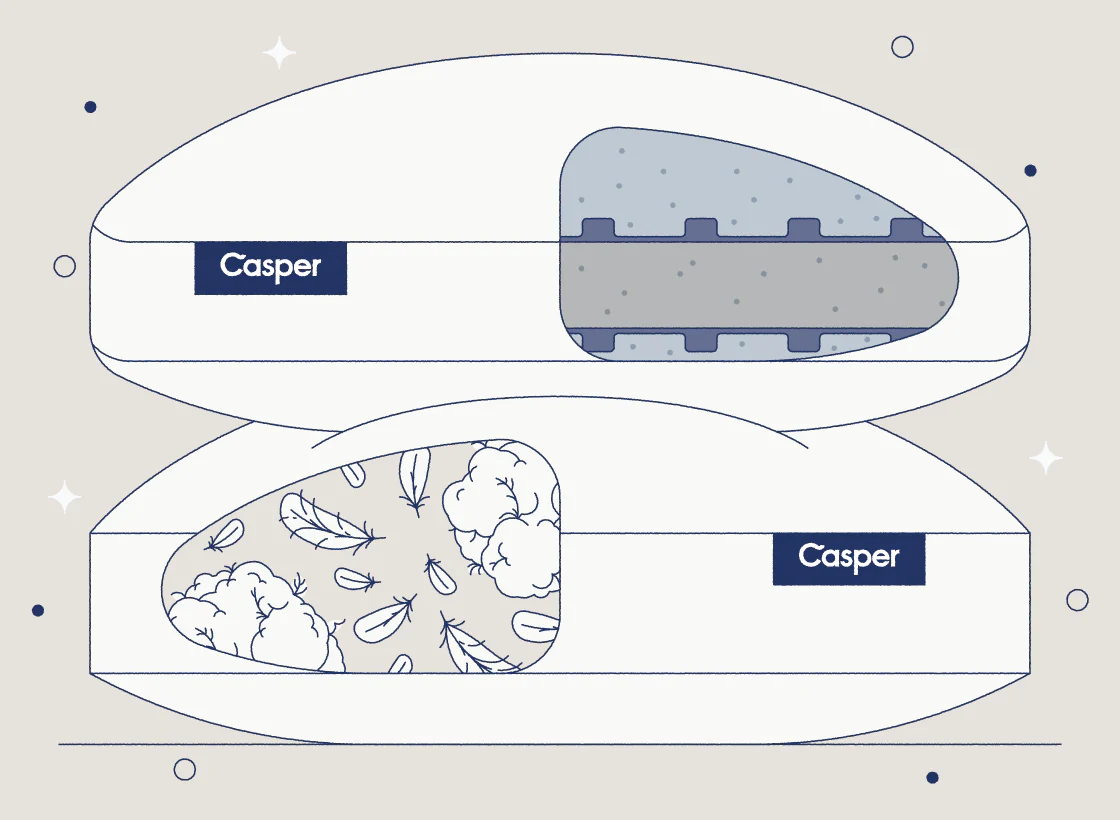
What Does “Pillow Lifespan” Actually Mean?
A pillow has reached the end of its useful life when it can no longer do one or more of these jobs:
- Provide stable support: The fill should hold your head without collapsing into a hard, flat, or uneven surface.
- Maintain suitable loft: The height should still match your body, mattress, and sleep position.
- Recover its shape: Compression should not remain permanent after the pillow is fluffed or unloaded.
- Stay cleanable: Normal soil and odor should be removable using the manufacturer’s approved care method.
- Dry completely: A washable or spot-cleaned pillow must not trap moisture inside.
- Remain structurally intact: The shell, seams, zipper, foam, and fill should not be breaking down.
Sleep Foundation’s pillow-testing methodology similarly treats durability as the ability to resist wear and maintain shape, while noting that actual life depends on materials and how the pillow is used and cared for. Read its pillow research methodology.
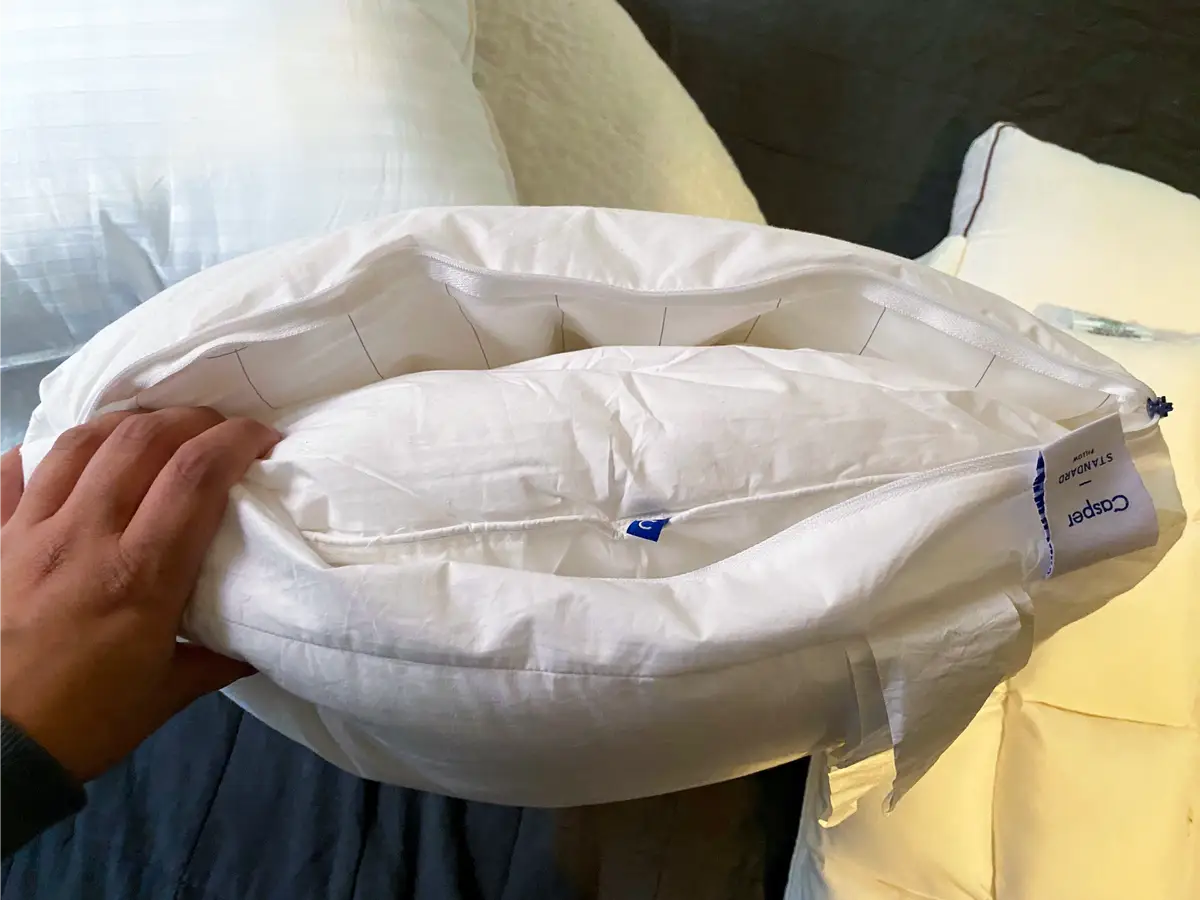
10 Signs It Is Time to Replace Your Pillow
1. The pillow stays flat after you fluff it
Temporary flattening is normal for some fiber and down pillows. The problem is persistent collapse: you shake, knead, or dry it according to the label, but the pillow becomes flat again within minutes or overnight.
2. The fill has hard lumps or empty zones
Uneven fill creates alternating high and low areas. If the lumps cannot be redistributed after approved washing and complete drying, the internal structure may be permanently damaged.
3. Foam recovers slowly or keeps a deep impression
Memory foam should respond gradually, but an old foam pillow may remain compressed, feel unusually soft in one area, or stop returning to its original contour. Cracks and crumbling are clear structural failure.
4. You repeatedly fold, stack, or place an arm under it
These adjustments often mean the pillow is no longer providing enough height or stable support. The habit alone is not proof of failure, but it is a useful clue when combined with flattening or discomfort.
5. The pillow no longer keeps your head comfortably aligned
Cleveland Clinic advises using a pillow that keeps the neck parallel to the mattress instead of bending sharply upward, downward, or to the side. See Cleveland Clinic’s pillow and neck-support guidance.
6. You wake with new stiffness or pressure that improves elsewhere
A worn pillow is one possible cause, but not the only one. Daytime posture, mattress condition, sleep position, injury, and health conditions can also contribute. Cleveland Clinic reported in 2026 that inadequate head support can place neck and shoulder muscles in an awkward position and contribute to morning tension or headache. Read Cleveland Clinic’s signs-you-may-need-a-new-pillow guidance.
7. Odor remains after approved cleaning and complete drying
A temporary smell after washing may mean the pillow is still damp. A persistent odor after correct cleaning and full drying can indicate deeply embedded body soil, contamination, or moisture that the material cannot release.
8. The pillow has visible mold or recurring dampness
Porous fill can be difficult to clean after mold penetrates below the surface. Do not keep re-covering a pillow that remains moldy, musty, or damp after treatment.
9. The shell is torn or the fill leaks out
A small seam may be repairable, but widespread fabric thinning, broken zippers, leaking feathers, or crumbling foam indicates declining construction.
10. Cleaning no longer restores a usable result
If the label-approved wash leaves the pillow permanently clumped, misshapen, stiff, or unable to dry, another wash may cause more damage rather than fix it.
Consider replacement when a non-washable core has been deeply soaked by urine, vomit, floodwater, or another biological spill; when visible mold cannot be completely removed; or when the pillow cannot be fully dried.
The Two-Minute Pillow Audit
Use this audit every few months or whenever sleep comfort changes. Do not rely on one test alone.
Folding a polyester or down pillow may reveal poor recovery, but it is not appropriate for molded foam, contoured cervical pillows, latex, buckwheat, or rigid specialty designs. Evaluate each pillow according to its construction.
How Sleep Position Changes the Replacement Decision
A pillow may look acceptable but have the wrong effective loft after months of compression. Cleveland Clinic advises that pillow height should keep the neck straight rather than extended too far upward or downward. See Cleveland Clinic’s neck-position guidance.
Mattress firmness also changes the required loft. On a firmer mattress, the shoulder sinks less, leaving a larger space to fill for side sleeping. On a softer mattress, more shoulder sink may make a lower pillow appropriate.
A new pillow should not be presented as a treatment for persistent pain. Seek professional medical advice when neck pain is severe, follows an injury, persists, spreads into the arm, or is accompanied by weakness, numbness, fever, headache, or other concerning symptoms.

Do Yellow Stains, Allergies, or Dust Mites Mean You Need a New Pillow?
Yellowing alone does not always require replacement
Yellow stains commonly come from sweat, skin oils, saliva, wet hair, skincare, or makeup. If a washable pillow can be cleaned, rinsed, dried fully, and still provides support, mild remaining discoloration may be cosmetic.
Use our material-specific guide on how to get yellow stains out of pillows before deciding that every yellow pillow must be discarded.
Recurring odor is more important than color
A stain may remain visible after the residue is removed. By contrast, odor that returns after proper cleaning and full drying suggests material remains inside the pillow or moisture is trapped in the fill.
Allergy management may justify a stricter schedule
The Asthma and Allergy Foundation of America recommends allergen-barrier pillow covers, weekly hot-water washing of washable bedding, and pillow replacement every two years as part of dust-mite control guidance. Read AAFA’s dust-mite allergy guidance.
That two-year recommendation is a household-allergen strategy, not proof that every older pillow is unsafe. People with diagnosed dust-mite allergy may need a more rigorous approach than households without allergy concerns.
Can You Revive a Flat Pillow?
Polyester and down-alternative
If the label permits it, washing and a thorough low-heat drying cycle with clean dryer balls may redistribute fill. Stop if seams weaken or the fill becomes more uneven.
Down and feather
Correct washing, complete drying, and repeated fluffing can restore some loft. A pillow that repeatedly collapses, leaks, or holds damp clumps is near the end of its useful life.
Memory foam
Air the pillow, vacuum it, and redistribute shredded fill when the design allows. A permanent impression, crack, or crumbling solid core cannot be repaired through washing.
Adjustable pillows
Some adjustable pillows can be refreshed by redistributing or adding manufacturer-approved fill. Inspect the inner liner, zipper, and shell before adding material; extra fill cannot correct a damaged casing.
If the pillow returns to an unusable shape after one night, repeated fluffing is maintenance—not restoration. Replacement may be more practical.
How to Extend a Pillow’s Useful Life
- Use both a pillowcase and washable protector. The protector reduces the amount of sweat, oils, skincare, and saliva reaching the insert.
- Follow the care label. Incorrect machine washing, soaking, or high heat can shorten life dramatically.
- Use the correct amount of detergent. Excess detergent can remain in thick fill and make it stiff or difficult to dry.
- Dry the center completely. Do not put the cover back on while the insert is cool, heavy, or damp.
- Fluff compatible fills regularly. Redistribute down, feather, and fiberfill before permanent clumps develop.
- Keep foam away from high heat. Heat can deform or weaken memory foam and latex.
- Address spills immediately. Blot rather than pushing liquid deeper into the fill.
- Store spare pillows dry and breathable. Avoid damp basements, hot attics, and sealed plastic around a pillow that is not fully dry.
Before washing any entire pillow, check which pillow fills can go in a washing machine. For solid foam, follow our guide to cleaning memory foam with minimal moisture.
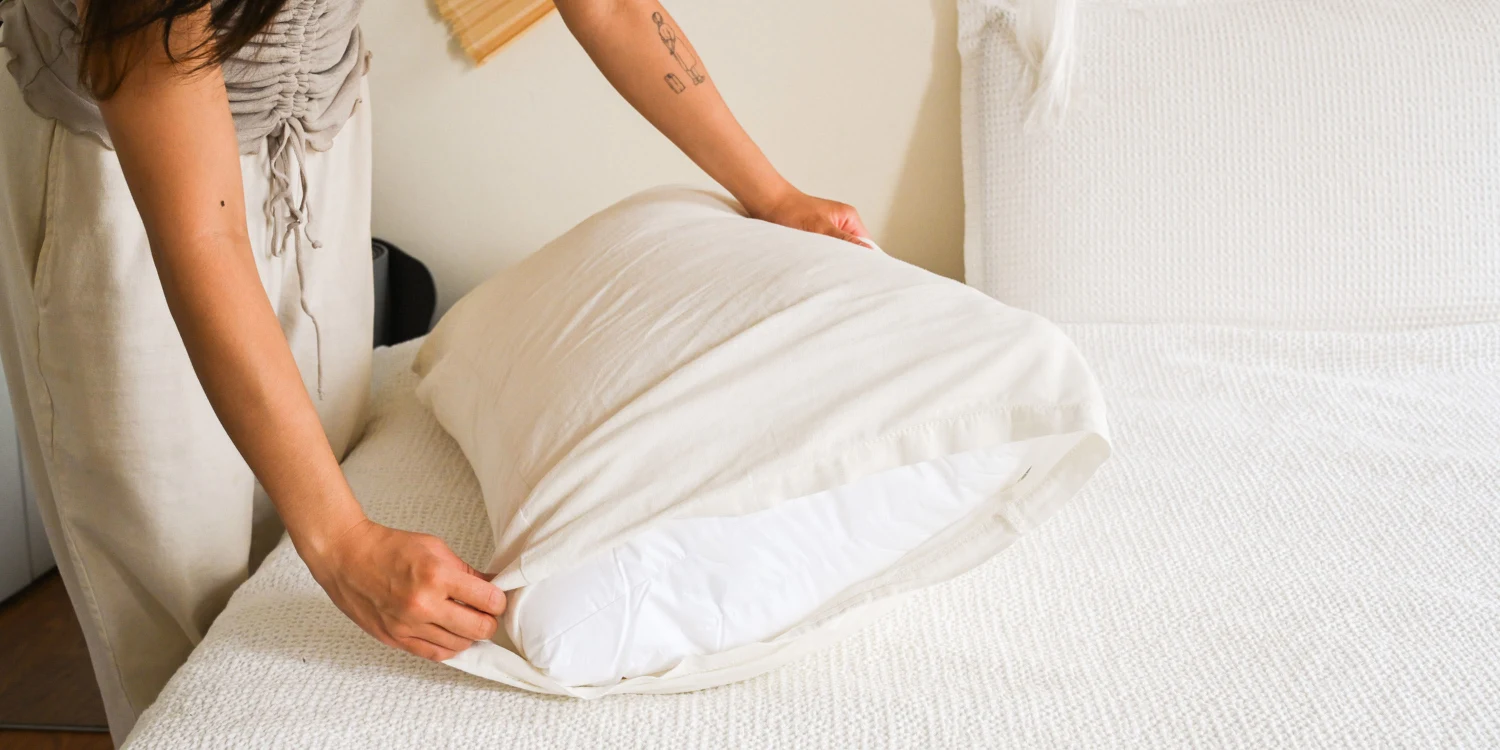
Should You Clean, Revive, or Replace the Pillow?
| What you notice | Best next step | Reason |
|---|---|---|
| Fresh surface stain, support still good | Clean using the care label | The problem is localized and the structure is intact |
| Washable fiberfill is slightly flat | Wash, dry, and fluff once | Compatible fill may recover after complete drying |
| Shredded adjustable fill has shifted | Redistribute or refill when approved | The shell may still be sound even though loft is uneven |
| Permanent foam impression or crumbling | Replace | Structural foam failure cannot be cleaned away |
| Persistent odor after correct cleaning and drying | Replace or professionally assess | Contamination may remain deep inside |
| Visible mold in porous fill | Replace | Surface cleaning may not remove internal growth |
| Good condition but wrong height for your body | Change pillow type or adjust loft | The issue is fit rather than age |
When replacement is the sensible option, compare the current Contour Relief Pillow and Ultra Contour Relief Pillow. Choose based on your preferred position, mattress firmness, body proportions, and the product’s actual dimensions—not simply because the old pillow reached a certain age.
Frequently Asked Questions
How often should pillows be replaced?
One to two years is a common review point for regularly used pillows, but the actual decision should be based on material, condition, support, odor, cleanability, and whether the pillow recovers its shape.
Do memory foam pillows need replacing every two years?
Not automatically. Many memory foam pillows are evaluated around two to three years, but replace sooner if the foam develops permanent impressions, cracks, crumbling, uneven support, or contamination that cannot be safely cleaned and dried.
How long do down pillows last?
Many down and feather pillows fall within roughly one to three years, although high-quality construction and good care may extend useful life. Replace when fill no longer recovers, leaks, remains clumped, or develops persistent odor.
How long do latex pillows last?
Latex is generally more resilient than basic polyester fill and may remain usable for about two to four years. Heat exposure, tearing, crumbling, and permanent compression can shorten that range.
Does a yellow pillow always need to be replaced?
No. Yellowing may be cosmetic body-soil discoloration. Clean it using the approved method and replace it when odor, mold, contamination, structural damage, or loss of support remains.
Is the fold test a reliable way to judge a pillow?
Only for some flexible fiber or down pillows. Do not fold molded foam, cervical, latex, buckwheat, or rigid specialty pillows. Use shape, recovery, support, odor, and structural condition instead.
Can washing make an old pillow supportive again?
Sometimes. Washing and thorough drying may restore some loft to compatible down, feather, polyester, or down-alternative fill. It cannot repair broken foam, worn fibers, failed seams, or permanent compression.
Should I replace a pillow if I wake with neck pain?
A worn or poorly fitted pillow may contribute, but it is not the only possible cause. Check whether the pillow keeps your head and neck comfortably aligned. Persistent, severe, spreading, or injury-related pain should be evaluated by a healthcare professional.
How can I make a pillow last longer?
Use a washable protector, follow the care label, use modest detergent, dry the insert completely, keep foam away from heat, redistribute compatible fill, and address spills promptly.
Should guest-room pillows be replaced on the same schedule?
Not necessarily. Infrequently used guest pillows may last longer, but they still need inspection for storage moisture, odor, dust, pests, loss of shape, and fabric deterioration before use.
Related Pillow Care Guides
- Can You Machine Wash Pillows? A Fill-by-Fill Guide
- How to Clean a Memory Foam Pillow Without Damaging It
- How to Get Yellow Stains Out of Pillows Safely
- Should You Wash New Pillows Before Using Them?
Sources and Further Reading
Editorial note: Pillow lifespan ranges are general estimates rather than fixed expiration dates. Manufacturer instructions and the condition of your exact pillow take priority.
