
How much should a weighted blanket weigh? Use the manufacturer’s size-and-weight guide as the primary rule. Around 10% of body weight is a common starting point in consumer and occupational-therapy guidance, not a proven ideal or universal prescription. Choose a blanket sized for the individual user, start conservatively, and confirm that the person can remove it easily, change position, breathe normally, and remain comfortable. A blanket that causes restricted movement, breathing difficulty, overheating, pain, numbness, nausea, panic, or a trapped feeling is too heavy or otherwise unsuitable.
The number printed on the package is only one part of the choice. The same total weight can feel very different when spread over a small throw, a wide queen blanket, a loosely knitted design, or a tightly quilted blanket. Body size, blanket dimensions, fill distribution, sleeping position, mobility, temperature, and personal preference all affect how the pressure feels.
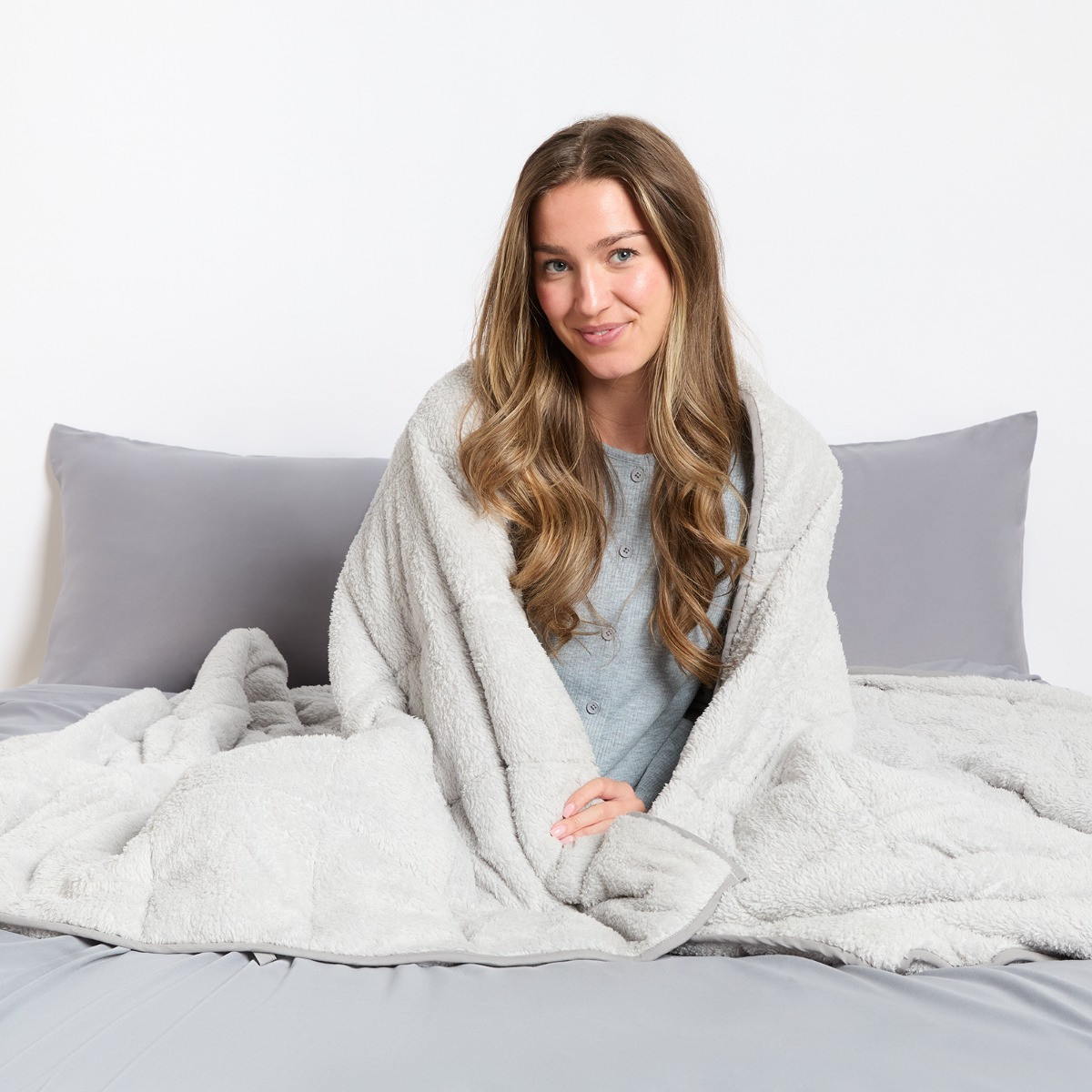
How Much Should a Weighted Blanket Weigh Under the 10% Rule?
Around 10% of body weight is widely used as a shopping starting point. Some occupational-therapy guidance says manufacturer instructions often limit the blanket to no more than 10% of the user’s body weight. However, that figure should not be treated as a clinically proven sweet spot, a dose, or a guarantee of safety.
Body weight × 0.10 = an approximate comparison point.
After calculating, compare the result with the exact product’s approved age, user size, dimensions, weight options, and use instructions. When the result falls between two options, choosing the lighter model is generally more conservative than rounding up automatically.
Somerset NHS Foundation Trust, using guidance adapted from the Royal College of Occupational Therapists, says to follow manufacturer advice on size and weight and notes that this often limits a weighted blanket to no more than 10% of body weight. Its child guidance also requires independent removal, an uncovered head and neck, no restraint or rolling, and removal once the child is asleep. Read the current NHS guidance.
Clinical studies have used different fixed blanket weights and protocols. They do not establish that exactly 10% produces the best sleep, anxiety, pain, hormone, or nervous-system outcome for every person.
Choose a Weighted Blanket in Six Steps
- Confirm who will use it. Do not size from the mattress or the combined weight of everyone sharing the bed. Identify one intended user.
- Read the product guide first. Check age restrictions, body-size range, blanket dimensions, total weight, intended use, warnings, and whether overnight use is approved.
- Use 10% only as a comparison point. Calculate it, then stay within the manufacturer’s options and limits rather than forcing the result.
- Prefer the lighter choice when uncertain. This is especially important for first-time users, hot sleepers, side sleepers, people who move frequently, and anyone prone to claustrophobia.
- Test while awake. Place the blanket loosely over the body, keep the face and neck clear, and check whether the user can turn, sit up, remove it, and breathe comfortably.
- Judge the whole response. Keep it only when pressure, temperature, movement, and emotional comfort remain acceptable. Stop immediately for warning signs.
Manufacturer-approved and easy to remove
The user wants the pressure, can control the blanket independently, and the weight feels noticeable without restricting movement.
Heat, side pressure, mobility, or health concern
The user sleeps hot, has pain, reduced sensation, breathing or circulation concerns, limited movement, or takes medication affecting alertness.
Breathing, movement, or distress changes
Remove the blanket for difficulty breathing, inability to escape, panic, nausea, overheating, numbness, pain, or unusual weakness.
Why Blanket Size Changes How the Weight Feels
Total pounds do not tell you how concentrated the pressure will be. A 15-pound throw-sized blanket places the weight over a smaller area than a 15-pound queen-size blanket. A wide blanket may also extend beyond the body and mattress, reducing useful pressure over the user while creating downward pull at the edges.
| Situation | Practical direction | Reason | Avoid |
|---|---|---|---|
| First weighted blanket | START CONSERVATIVELY | A lighter approved option is easier to test and remove | Rounding up for “stronger benefits” |
| Hot sleeper | REVIEW WEIGHT AND FABRIC | Total warmth depends on fill, shell, layers, room temperature, and weight | Assuming heavier always means more effective |
| Side sleeper or localized pain | TEST PRESSURE CAREFULLY | Pressure may concentrate over shoulders, hips, knees, or painful areas | Ignoring pain, tingling, numbness, or soreness |
| Reduced mobility or sensation | GET PROFESSIONAL GUIDANCE | The user may not detect pressure or remove the blanket promptly | Using a percentage as proof of safety |
| Breathing difficulty or trapped feeling | REMOVE IMMEDIATELY | The blanket is too heavy, incorrectly positioned, or unsuitable | Waiting for the user to “get used to it” |
Should Couples Share One Weighted Blanket?
- Choose by the actual user rather than by bed size.
- Do not place one person’s chosen blanket over a partner who does not want it.
- Keep each person’s face and neck clear.
- Make sure either person can exit without the other person’s body trapping the blanket.
- Use separate blankets when body size, heat preference, pressure preference, or health needs differ.
How Heavy Should a Weighted Blanket Be for a Child?
Do not use a universal child weight chart. Infants must never use weighted blankets, weighted swaddles, weighted sleepers, or other weighted objects in the sleep environment. The American Academy of Pediatrics recommends that weighted objects not be placed on or near a sleeping infant. Read the AAP safe-sleep policy.
For an older child, age and body weight alone do not establish safety. Use individualized pediatric or occupational-therapy guidance, the exact manufacturer’s limits, and the independent-removal test. Somerset NHS guidance says the blanket must not restrain the child, cover the head or neck, hang over the bed sides, or remain on overnight; remove it when the child falls asleep.
A chart can falsely imply that reaching a certain age, body weight, or percentage makes overnight use safe. Product design, ability to escape, health, communication, supervision, and intended use remain essential.
See the complete safety guide: Are Weighted Blankets Safe for Kids?.
Health and Mobility Considerations
Ask a qualified clinician before use when pressure, warmth, or reduced movement could worsen a condition. Important examples include breathing disorders, circulation problems, impaired sensation, neuromuscular weakness, limited mobility, recent surgery, swelling, significant pain, skin injury, claustrophobia, or medication that causes unusual drowsiness.
- Do not place concentrated weight over an injury, surgical site, painful joint, swollen limb, or area with reduced sensation.
- Do not rely on a lighter percentage to make an unsuitable situation safe.
- Do not use the blanket as restraint, behavior control, fall prevention, or a substitute for supervision.
- Stop for pain, numbness, tingling, shortness of breath, panic, overheating, nausea, or weakness.
- Persistent insomnia, loud snoring, breathing pauses, severe anxiety, or daytime sleepiness deserves clinical assessment rather than a heavier blanket.
Signs a Weighted Blanket Is Too Heavy
Remove the blanket immediately rather than reducing the exposure time or waiting for adaptation. Severe breathing difficulty, unresponsiveness, blue or gray coloring, or another life-threatening symptom requires emergency help.
Do Heavier Blankets Provide More Benefits?
No reliable evidence shows that increasing blanket weight produces proportionally greater sleep, anxiety, pain, hormone, or nervous-system benefits. Adult studies have used different fixed weights rather than validating a universal percentage. A randomized insomnia trial used an 8-kilogram blanket against a lighter control, while a chronic-pain trial compared 15-pound and 5-pound blankets. These study designs do not establish that every person should select either weight or increase pressure until a benefit appears.
For a balanced review of what research does and does not support, read What Are Weighted Blankets Good For?.
Care for the Weight You Choose
A blanket that becomes lumpy, damaged, damp, or uneven may no longer distribute its listed weight safely. Inspect seams and fill pockets, follow the exact wash label, and confirm that the washer and dryer can handle the load.
Read How to Wash Weighted Blankets Safely before cleaning the filled layer.
Complete the Sleep Setup
A weighted blanket changes pressure and warmth; a dedicated sleep pillow supports the head and neck. These are different functions. The following Pallas Cozy options are sleep pillows rather than weighted products.
SLEEP PILLOW
Contour Relief Pillow
View the current construction, dimensions, and care information.
SLEEP PILLOW
Ultra Contour Relief Pillow
Compare the current model details and product care guidance.
Frequently Asked Questions
Is 10% of body weight the correct weighted blanket size?
It is a common starting point, not a proven ideal or universal prescription. Follow the product guide and choose a weight the user can remove easily and tolerate comfortably.
Should I round up or down?
When both options are allowed by the manufacturer and you are uncertain, rounding down is the more conservative first trial. Do not round up to seek stronger effects.
Can a weighted blanket be less than 10%?
Yes. A lighter manufacturer-approved option may be better for a first-time user, hot sleeper, side sleeper, frequent mover, or anyone sensitive to pressure.
Can a weighted blanket be more than 10%?
Do not exceed the product’s limit. More weight is not proven to deliver more benefit and can make movement, breathing, heat control, or removal harder.
Does blanket size affect the weight choice?
Yes. The same total pounds spread over a larger area generally feels less concentrated, while excessive overhang can pull the blanket away from the user and make removal harder.
How heavy should a weighted blanket be for a couple?
Two individual blankets are usually more controllable. Do not add or average both body weights and assume one shared blanket distributes pressure evenly.
How heavy should a weighted blanket be for a child?
Do not use a generic chart. Infants must not use weighted sleep products. For older children, use individualized professional and manufacturer guidance and require easy independent removal.
How do I know the blanket is too heavy?
Remove it for restricted movement, breathing discomfort, overheating, pain, numbness, nausea, panic, weakness, or inability to get free without help.
Will a heavier blanket help anxiety or insomnia more?
That dose-response relationship has not been established. A heavier blanket may simply be hotter, less mobile, or more uncomfortable.
Should the blanket cover the whole mattress?
Usually the product should fit the intended user rather than drape like an ordinary comforter. Follow its dimensions and placement instructions and avoid unsafe overhang.
Related Pallas Cozy Guides
Sources and Further Reading
Editorial note: This article provides general sizing and safety information, not a medical prescription. Product instructions and individualized clinical or occupational-therapy guidance take priority.
