
How to dry a wet mattress: remove all bedding, stop the leak or spill source, blot or extract as much liquid as possible without rubbing, move air across every wet surface, reduce room humidity, and keep the mattress uncovered until the inside as well as the surface is completely dry. A small clean-water spill may be recoverable at home. Floodwater, sewage, visible mold, a persistent musty odor, or deep saturation usually calls for professional assessment or replacement rather than repeated home drying.
Speed matters, but heat and guesswork can make the damage worse. A mattress may feel dry on top while foam, quilting, fiber, springs, or the underside still holds moisture. The goal is not to meet a fixed 24-hour timer; it is to remove bulk liquid quickly, create continuous airflow, lower humidity, and verify that no dampness or contamination remains.
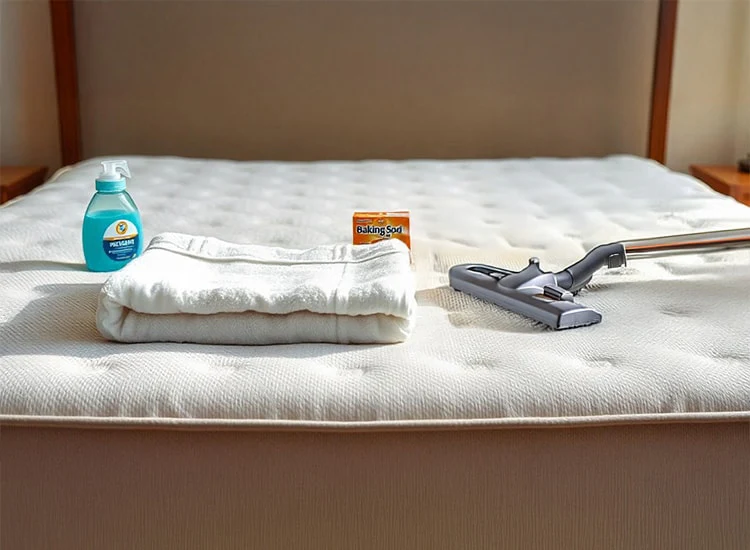
Can a Wet Mattress Be Saved?
Small, recent clean-water spill
The liquid is limited to the surface, the source is known, there is no odor or mold, the mattress is structurally intact, and drying begins immediately.
Large spill or uncertain depth
Water reached deep quilting or foam, the mattress has smart components, the cover cannot be removed, or the underside and foundation are also wet.
Floodwater, sewage, mold, or prolonged saturation
Contaminated or moldy porous layers cannot reliably be disinfected and inspected through their full depth at home.
CDC advises drying a flooded home and its contents within 24–48 hours when possible; items wet with floodwater that cannot be cleaned and dried completely in that period should be removed. EPA likewise says to remove or discard belongings that remain wet and warns that floodwater may carry sewage or chemicals. Read CDC’s mold-cleanup tips and EPA’s flooded-home guidance.
A mattress is porous. Contamination can travel beyond the visible wet area into foam, fiber, seams, springs, and the foundation. Photograph damage for insurance before disposal when appropriate.
What You Need for a Clean-Water Spill
- Several clean, dry absorbent towels
- Fan with a stable, safe power setup
- Dehumidifier when indoor humidity is high
- Gloves when the liquid or stain is uncertain
- Clean blocks, slats, or another stable support for airflow below
- Wet/dry vacuum approved for liquid extraction
- Moisture meter for comparing the wet area with a known-dry area
- Mild mattress-compatible spot cleaner
- Dry baking soda for surface odor only when powders are permitted
- Professional water-restoration equipment for deep wetting
Do not use a space heater, open flame, iron, heated pad, high-heat hair dryer, or the mattress’s own heated feature to force drying. High heat can damage foam, adhesives, upholstery, fire barriers, and electrical components while creating a fire risk.
How to Dry a Wet Mattress in Six Steps
- Make the area safe. Stop the leak, keep electrical devices away from standing water, and do not operate fans or extractors until the room’s electrical system is safe. Remove the mattress from a wet frame, carpet, wall, or foundation when it can be moved without injury or structural damage.
- Strip every wet layer. Remove sheets, blankets, protector, topper, pad, and any manufacturer-approved removable cover. Launder or discard each item according to its own label and contamination level.
- Blot or extract bulk liquid. Lay dry towels over the wet area and press firmly, then replace them as they become saturated. Do not rub. Use a wet/dry vacuum only when appropriate for the mattress and contamination and never use a standard dry vacuum on liquid.
- Expose more surface area. Position the mattress flat, on its side, or on a ventilated support only as its construction permits. Keep it stable, avoid sharp bends, and make sure air can reach the underside, edges, seams, and foundation.
- Run continuous airflow and dehumidification. Aim fans across rather than directly into one tiny area, keep interior doors configured for the dehumidifier’s instructions, and open windows only when outdoor air is drier and conditions are safe.
- Inspect repeatedly before use. Compare the affected area with a dry section. Continue drying if the surface or interior feels cooler, heavier, softer, clammy, or musty, or if moisture readings remain elevated.
For a small spill on a Tempur-Pedic mattress, the manufacturer says to blot excess liquid immediately without rubbing, avoid saturating a non-removable cover, and allow the mattress to air-dry completely with a fan. It also warns that TEMPUR material should not be soaked or washed. See Tempur-Pedic’s current instructions.
Set Up Airflow Without Damaging the Mattress
EPA recommends using fans and dehumidifiers to speed drying when electricity is safe. When visible mold is already present, EPA warns against using fans because airflow can spread mold to other areas. Review EPA’s flood-cleanup guidance.
Outdoor air can help only when weather is dry, the mattress can be moved safely, and the manufacturer allows sun exposure. UV and heat can discolor or degrade some foams, fabrics, latex, adhesives, and cooling materials. Keep the mattress away from dirt, pollen, insects, dew, rain, and excessive heat.
How to Know When the Mattress Is Completely Dry
Do not cover the mattress with plastic, a protector, sheets, or bedding to “test it overnight.” Covering a damp mattress traps moisture and hides odor. Sleep elsewhere until the mattress and foundation are confidently dry.
Does Baking Soda Dry a Wet Mattress?
Baking soda may absorb a small amount of surface moisture and odor, but it cannot replace towel extraction, airflow, dehumidification, or professional drying. It does not pull a large spill from deep foam and does not disinfect floodwater or sewage contamination.
- Use it only after bulk liquid has been removed and the surface is merely damp or dry.
- Check whether powders and vacuuming are permitted for the cover.
- Apply a light layer rather than burying the area.
- Do not mix it with essential oils or cleaning chemicals.
- Remove it completely with a suitable dry vacuum only after the powder is dry.
- Stop if powder enters vents, sensors, air chambers, exposed foam, or damaged seams.
A dry powder layer on top can coexist with wet foam underneath. Always check the mattress itself after the powder is removed.
Drying Guidance by Mattress Type
| Mattress type | Home-drying outlook | Main concern | Best next step |
|---|---|---|---|
| Memory foam or all-foam | LIMITED | Dense foam can retain water below a dry-looking surface | Blot immediately, maximize airflow, contact the maker for deep wetting, and replace when saturation cannot be verified as dry |
| Hybrid | LIMITED | Foam can trap moisture while springs and internal components may corrode | Inspect the foundation and underside and seek professional help for more than a small surface spill |
| Traditional innerspring | PRODUCT-SPECIFIC | Upholstery, fiber, padding, and metal can all remain wet or damaged | Do not assume springs make it easy to dry; use the same moisture checks and maker guidance |
| Latex | PRODUCT-SPECIFIC | Latex layers, adhesives, holes, and cover construction vary | Avoid direct heat and sunlight unless the manufacturer permits them |
| Pillow-top or Euro-top | SLOWER | Deep quilting can hold moisture and mask wet layers | Use prolonged airflow and professional assessment for deep wetting |
| Smart, air, or electrically powered bed | STOP AND CONTACT MAKER | Moisture may reach pumps, sensors, wiring, connectors, or air chambers | Disconnect only as instructed and do not power the system until the manufacturer clears it |
When to Replace a Wet Mattress Instead of Drying It
A mattress cannot be opened and disinfected like a hard surface without destroying its construction.
EPA says wet porous materials may need to be discarded when they cannot be cleaned and dried completely. After a flood, it advises removing and discarding items that remain wet for more than 24–48 hours. Read EPA’s flooding guidance.
Replacement or professional restoration is usually the safer route when:
- The mattress contacted sewage, floodwater, stormwater carrying debris, or an unknown contaminated liquid.
- Visible mold appears on the cover, seams, underside, foundation, wall, or floor near the mattress.
- A musty odor persists or returns after the mattress appears dry.
- Water penetrated the full depth of thick foam, quilting, or an attached pillow top.
- The mattress remained wet or enclosed long enough that complete drying is doubtful.
- Smart-bed, heated, sensor, pump, cable, or control components became wet.
- Foam softened, crumbled, hardened, warped, split, or changed shape.
- Springs, fasteners, or internal components rusted or began making new sounds.
- The fire barrier, cover, zipper, seams, or adhesives were damaged.
- Someone in the household has asthma, mold allergy, chronic lung disease, or a weakened immune system and hidden contamination cannot be ruled out.
Prevent the Next Mattress Spill
- Use a washable waterproof protector compatible with the mattress and warranty.
- Fix roof, window, plumbing, air-conditioner, and foundation leaks before returning the bed to place.
- Keep the mattress and foundation away from damp walls and floors.
- Inspect under the bed after storms, plumbing work, condensation, and humid periods.
- Blot small spills immediately rather than leaving wet bedding in place.
- For repeated nighttime accidents, use layered washable protection and address the underlying medical, behavioral, or pet-care issue.
For routine low-moisture care after the emergency is resolved, read How to Clean a Mattress Safely.
Complete the Sleep Setup
A dry, clean mattress is only one part of the bed. The following Pallas Cozy products are dedicated sleep pillows, not drying equipment.
SLEEP PILLOW
Contour Relief Pillow
View the current construction, dimensions, and care information.
SLEEP PILLOW
Ultra Contour Relief Pillow
Compare the current model details and product care guidance.
Frequently Asked Questions
How long does a wet mattress take to dry?
There is no reliable universal time. A small surface spill may dry much faster than deep foam saturation. Use condition, odor, underside checks, and moisture comparison rather than a fixed hour count.
Can I sleep on a slightly damp mattress?
No. Bedding and body heat can trap moisture, while deeper layers may remain wet. Sleep elsewhere until the entire mattress and foundation are dry.
Will a fan dry a wet mattress?
A fan helps evaporation when electricity is safe and there is no visible mold. A dehumidifier and airflow beneath the mattress are often needed for deeper or broader wetting.
Can I use a hair dryer?
Avoid concentrated heat unless the manufacturer specifically approves it. High heat can damage foam, fabric, adhesives, and fire barriers and may create a fire risk.
Should I put a wet mattress in the sun?
Only when the manufacturer permits sunlight, weather is dry, and the mattress can be moved safely. Sun and heat can damage some latex, foam, fabrics, and cooling materials.
Does baking soda remove moisture from inside a mattress?
No. It may absorb a little surface moisture or odor, but it cannot dry deep foam or replace extraction, moving air, lower humidity, and complete inspection.
Can a flooded mattress be saved?
Usually it should be discarded because floodwater may contain sewage, bacteria, and chemicals, and porous layers cannot be reliably cleaned through their full depth.
How do I know whether mold is inside?
Visible spots, a recurring musty odor, prolonged wetness, and damp internal readings are warning signs. Hidden mold cannot always be confirmed without destructive inspection, so professional advice or replacement may be safer.
Can I use a wet/dry vacuum?
It can remove bulk clean water when the equipment and mattress construction permit it. Never use a standard dry vacuum on liquid, and do not use home extraction for sewage or floodwater.
What if only the underside is wet?
Remove the mattress from the wet foundation, inspect both pieces, create airflow above and below, and investigate the leak or condensation source. The underside still needs complete drying.
Related Pallas Cozy Guides
Sources and Further Reading
Editorial note: This guide covers small clean-water incidents and general drying decisions. Product instructions, electrical safety, flood-cleanup guidance, insurance requirements, and qualified restoration or medical advice take priority.
