
A mattress cannot usually be washed like sheets or a removable cover. Its foams, fibers, adhesives, springs, cooling layers, fire barrier, quilting, and upholstery can react differently to water and cleaners. The safest process uses dry soil removal first, then the smallest amount of moisture necessary for a specific stain.
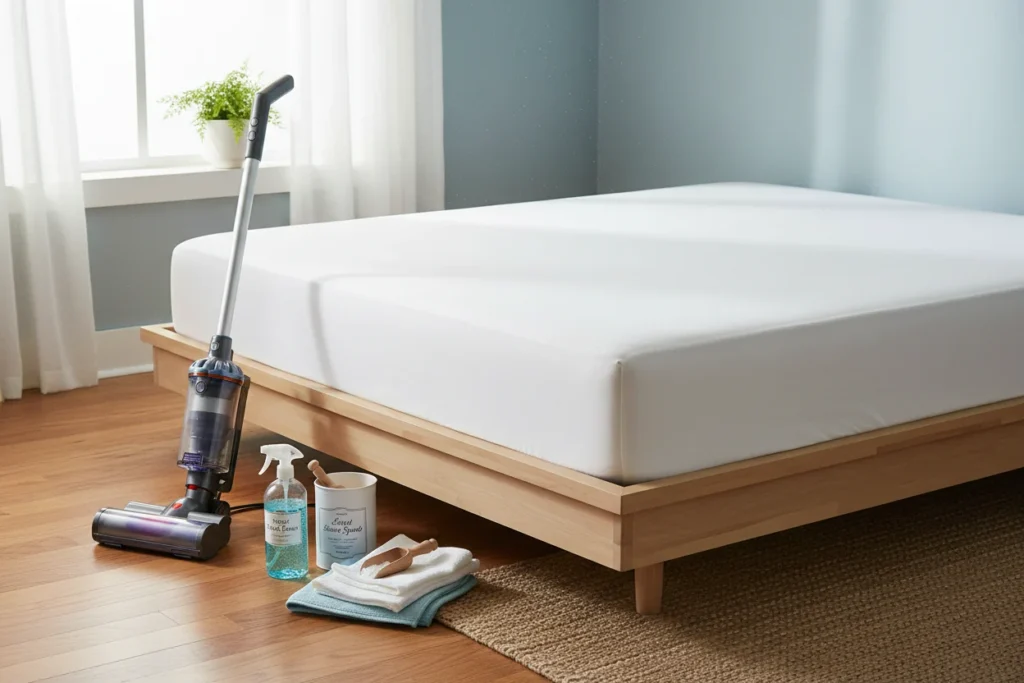
Choose the Right Mattress-Cleaning Route
Tempur-Pedic instructs owners to blot spills without rubbing, spot-clean non-removable covers without saturating the mattress, and air-dry completely with a fan when needed. It also notes that removable covers and non-removable covers can have different instructions even within one brand. Review Tempur-Pedic’s spill guidance.
Supplies for a Low-Moisture Cleaning Session
- Vacuum with a clean upholstery and crevice attachment
- Several clean white cloths or absorbent towels
- Small bowl of water at the temperature allowed by the label
- Mild detergent or product-specific cleaner
- Fan and, when helpful, a dehumidifier
- Enzyme cleaner approved for the cover fabric
- Baking soda for dry odor absorption when the manufacturer does not prohibit powders
- Gloves for body-fluid or unknown stains
- Mattress protector or encasement after cleaning
- Professional cleaning or restoration contact for complex contamination
Avoid chlorine bleach, ammonia, solvent cleaners, essential oils, strong fragrance, carpet shampoo, and homemade chemical combinations unless the mattress manufacturer specifically approves the product and method. Never mix cleaning chemicals.
How to Clean a Mattress in Eight Steps
- Read the mattress and cover labels. Identify the exact model, removable-cover status, prohibited cleaners, water limits, drying instructions, and whether vacuuming, steam, or professional care is restricted.
- Strip the bed completely. Remove sheets, pillowcases, blankets, toppers, pads, and the protector. Launder each item according to its own label.
- Inspect before cleaning. Look for tears, exposed foam, damaged fire-barrier fabric, pests, mold, strong musty odor, saturation, broken springs, or a stain that appears to extend deeply.
- Vacuum the dry mattress. Use slow overlapping passes across the top, sides, seams, piping, tufts, handles, and edges. Do not press so hard that the attachment damages the cover.
- Treat one small stain at a time. Apply a compatible cleaner to a cloth, wring it until barely damp, and blot from the outside of the mark toward the center.
- Remove cleaning residue. Use a second barely damp cloth only when the product instructions call for rinsing, then press with a dry towel to remove moisture.
- Dry with unrestricted airflow. Keep sheets off, aim a fan across the treated area, reduce room humidity when possible, and turn or elevate the mattress only as the manufacturer permits.
- Reinspect and protect. Do not remake the bed until the surface, seams, underside, and any treated area are dry, odor-free, and structurally normal. Add a clean protector and bedding.
Casper’s current guidance similarly recommends vacuuming, mild spot care, baking soda for odor when appropriate, and avoiding saturation because foam cores can absorb water and detergent. See Casper’s mattress-cleaning guide.
Mattress Stain Guide: Use the Smallest Effective Treatment
| Stain or condition | First action | Possible cleaning route | When to stop |
|---|---|---|---|
| Fresh clear liquid | BLOT NOW | Press clean towels into the area without rubbing; follow with model-approved spot care only if residue remains | Liquid reached deep foam, electronics, air channels, or an adjustable smart-bed component |
| Blood | COOL, MINIMAL MOISTURE | Blot with cool water and a compatible enzyme or detergent product after hidden-area testing | Large body-fluid contamination, unknown exposure, or the label prohibits the chosen product |
| Urine, vomit, or protein soil | BLOT + ENZYME CHECK | Use an enzyme product only when compatible with the upholstery; treat the protector and removable cover separately | Deep saturation, persistent odor, repeated contamination, or compromised internal layers |
| Sweat or body oil | MILD SPOT CARE | Use a barely damp cloth with a small amount of mild detergent, then remove residue and dry fully | Discoloration is widespread, fabric dye changes, or the surface coating reacts |
| Food, drink, or cosmetics | IDENTIFY FIRST | Lift solids, blot liquid, and choose a cleaner for both the stain and upholstery material | Solvent, bleach, or abrasive treatment would be required but is not approved |
| Mold or musty odor | DO NOT MASK IT | Identify and stop the moisture source; obtain professional or manufacturer guidance | Visible mold, recurring odor, or suspected growth inside porous layers |
Should You Put Baking Soda on a Mattress?
Baking soda can help absorb some surface odor, but it does not disinfect the mattress, kill all dust mites, draw liquid from deep foam, or remove the cause of mold. It can also remain trapped in seams, textured covers, air channels, or internal layers if applied heavily.
- Check whether powders and vacuuming are permitted for the cover.
- Use only a thin layer on a dry mattress, not on a soaking-wet spill.
- Keep children and pets away during treatment.
- Do not add essential oils; fragrance can irritate sensitive users and may stain or damage materials.
- Vacuum slowly until no visible or gritty residue remains.
- Stop if powder enters vents, smart-bed hardware, exposed foam, or a damaged seam.
What to Do About Mold, Floodwater, or a Soaked Mattress
EPA says mold control depends on moisture control and that moldy porous materials may need to be discarded because growth can enter spaces and crevices that are difficult or impossible to clean completely. Read EPA’s mold-cleanup steps.
- Sewage or floodwater: Do not use a household spot-cleaning routine. Contamination can extend through the full depth of the mattress.
- Visible mold: Avoid aggressive brushing or ordinary vacuuming that may spread spores. Seek qualified advice and prepare for replacement.
- Deep saturation: Contact the mattress manufacturer and a restoration professional promptly. The surface may dry while interior foam remains wet.
- Musty odor after drying: Continued odor can indicate retained moisture or hidden growth.
- Health symptoms: Leave the affected room and seek appropriate medical advice for significant breathing symptoms or severe allergic reactions.
For an emergency drying workflow, read How to Dry a Wet Mattress.
Adjust the Method for Mattress Type
Tempur-Pedic’s current product-care information illustrates this model variation: many covers are removable and washable, while other covers are spot-clean only, and its foam material should not be soaked. See Tempur-Pedic Product Care.
How Often Should You Clean a Mattress?
There is no universal requirement to deep-clean every mattress on an exact six-month schedule. A practical routine is to inspect and vacuum it when changing seasonal bedding or whenever the protector is removed, then spot-clean immediately when a compatible treatment is needed.
- Vacuum or inspect sooner: pets on the bed, visible dust, renovation debris, food crumbs, or allergy concerns.
- Spot-clean immediately: spills, body fluids, cosmetics, food, and other fresh stains.
- Clean removable covers: according to their own labels and actual contact level.
- Use allergen controls: CDC recommends allergen-proof mattress and pillow covers, weekly bedding washing, complete drying, regular HEPA vacuuming, and lower indoor humidity for people whose asthma is triggered by dust mites. Review CDC asthma-trigger guidance.
- Replace rather than repeatedly clean: when support is failing, structural damage is present, contamination cannot be removed, or the mattress remains wet, stained, or musty.
Protect the Mattress After Cleaning
Do not use the protector to hide an unresolved damp or moldy mattress. A cover limits future exposure; it does not reverse contamination already inside the bed.
Complete the Sleep Setup
Cleaning the mattress does not replace cleaning or evaluating the pillows that sit on it. The following Pallas Cozy products are dedicated sleep pillows, not mattress-cleaning tools.
Frequently Asked Questions
Can you wash a mattress with water?
Do not wash or soak the full mattress unless the manufacturer explicitly provides that method. Most mattresses require dry vacuuming and tightly controlled spot care.
Can I steam-clean a mattress?
Only when the exact manufacturer approves it. Steam adds heat and moisture that can damage foam, adhesives, upholstery, electronics, or fire-barrier materials and may not dry fully.
Can I use hydrogen peroxide on a mattress?
Do not treat it as a universal cleaner. It can bleach or alter some covers and foams. Use only when the manufacturer and upholstery material permit it, after hidden-area testing.
Does baking soda sanitize a mattress?
No. It may absorb some surface odor, but it does not reliably disinfect, kill all mites, remove deep moisture, or solve mold.
How long should a mattress dry after spot cleaning?
There is no fixed safe time. Keep it uncovered with airflow until every treated area, seam, underside, and removable layer is dry and free from cool dampness or musty odor.
How often should I vacuum my mattress?
Inspect and vacuum during periodic bedding changes or when dust, pets, crumbs, renovation debris, or allergy needs justify it. Follow the mattress cover’s vacuuming instructions.
Can I remove and wash the mattress cover?
Only when the sewn label and product manual say it is removable and washable. Some zippered covers must remain on the mattress.
What should I do with a moldy mattress?
Stop the moisture source and seek professional or manufacturer guidance. Because mattresses are porous, visible or hidden mold may be difficult or impossible to remove completely.
Should I clean both sides of the mattress?
Vacuum and inspect accessible surfaces, but flip or rotate only as the manufacturer permits. One-sided and zoned mattresses may not be designed to flip.
When is replacement better than cleaning?
Replacement may be safer for sewage or floodwater exposure, persistent mold or musty odor, deep saturation, damaged internal layers, severe staining, pests that cannot be controlled, or failed support.
Related Pallas Cozy Guides
Sources and Further Reading
Editorial note: This guide provides general household care information. The exact mattress and cover labels, manufacturer instructions, warranty terms, and qualified mold, restoration, pest, or medical guidance take priority.
