
How to wash wool blankets safely: read the exact care label first. Machine-wash only when the blanket is labeled machine washable, using the specified wool or delicate cycle, the labeled water temperature, and a mild neutral wool detergent. Hand-wash only when the label allows it, with minimal movement and no wringing. Support the wet blanket fully, reshape it, and dry it exactly as directed—usually flat or evenly supported away from direct heat and harsh sunlight. Use professional cleaning when the label requires it or the blanket is vintage, trimmed, unstable, very large, or irreplaceable.
“Wool” describes the fiber, not one universal cleaning method. A washable Merino throw, a dry-clean-only woven heirloom, a felted blanket, a wool-blend quilt, and a cashmere blanket can react very differently to water, detergent, agitation, spin, and heat. The safest article-level rule is therefore simple: the maker’s care instructions override generic advice.
The three-part wool ruleUse only an approved cleaning route, minimize unnecessary movement while the fibers are wet, and support the blanket’s weight during transfer and drying. “Cold water only” is not a substitute for reading the care label.
How to Wash Wool Blankets: Choose the Correct Cleaning Route
Only when the label approves it
Use the listed cycle, temperature, detergent type, load size, spin, and drying method. Do not substitute a regular cycle because it is shorter.
Only when the label permits water washing
Dissolve the correct detergent first, move the blanket gently, avoid temperature shock, and support the full wet weight.
Dry-clean-only, unstable, or valuable
Follow the exact professional-care wording, especially when the blanket includes trim, lining, embroidery, leather, suede, or multiple materials.
Woolmark’s blanket-care guidance says heavily soiled wool blankets should follow their own care instructions; when machine washing is permitted, it recommends the gentle wool cycle, cold water, and a specified wool detergent. Woolmark also recommends airing and brushing wool blankets so full washing is needed less often. Review Woolmark’s blanket-care guide.
Unknown dyes, finishes, interlinings, stitching, trims, and previous repairs may react badly to water. Search the maker and model or consult a textile-care professional before wetting an unlabeled or valuable blanket.
Before Washing a Wool Blanket
- Read every care instruction. Check whether the blanket is washable, hand-washable, dry-clean-only, non-chlorine-bleach-only, tumble-dryable, line-dryable, or flat-dry-only. Follow warnings such as wash separately, no wring, reduced spin, or professional clean.
- Identify the complete construction. Look beyond the fiber percentage. Binding, fringe, embroidery, leather patches, backing, quilting, recycled blends, and decorative threads may have stricter limits than the wool itself.
- Inspect for damage. Weak seams, moth holes, loose fringe, split binding, felted patches, color instability, and previous repairs can worsen in water or agitation.
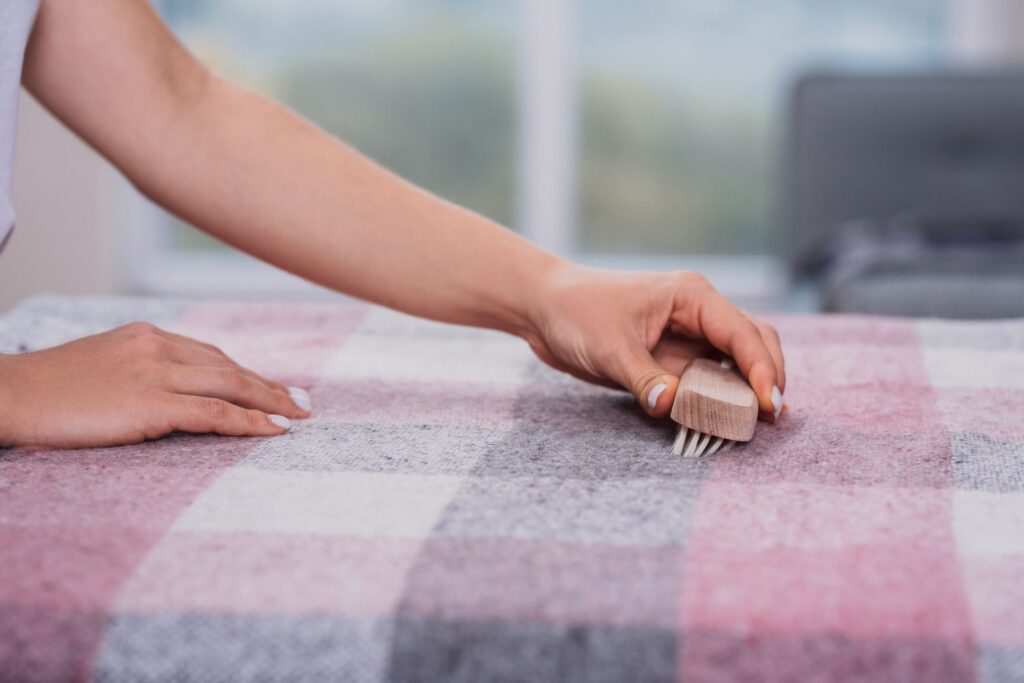
- Remove dry soil first. Shake outdoors when appropriate and use a soft garment brush along the surface direction. Avoid harsh vacuum suction or tools that pull yarn.
- Test color only when appropriate. Follow the maker’s advice. A hidden-area blot test may reveal transfer, but a clean test does not prove the entire blanket is washable.
- Plan the drying space before starting. Wet wool is heavy. Prepare clean towels, a supportive flat surface or approved line setup, airflow, and enough time for complete drying.
The FTC’s care-label guidance explains that care instructions should identify a safe regular-care procedure and warn against expected methods that would damage the textile. Although the U.S. rule mainly covers apparel and certain piece goods rather than every finished blanket, the same practical principle applies: follow the substantiated instructions attached to the product instead of inventing a harsher method. Read the FTC care-label explanation.
How to Machine-Wash Wool Blankets
Use this route only when the blanket is explicitly labeled machine washable and the washer can accommodate it without crowding or imbalance.
- Prepare the machine. Remove residue, pet hair, bleach, and sharp objects from the drum. Confirm that the machine has the cycle required by the label and enough usable capacity for the wet load.
- Load the blanket without compressing it. Wash alone or exactly as directed. Do not pack it around an agitator or force a large blanket into a small drum.
- Select the labeled water temperature. Many washable wool blankets specify cold water, but use the product’s own wording rather than choosing a temperature from a generic chart.
- Select the approved cycle and spin. Use a wool cycle when required. A generic “delicate” cycle may use a different movement pattern, duration, water level, or spin speed.
- Add the correct detergent dose. Use a mild neutral wool detergent in the dispenser or location directed by the washer and detergent labels. Do not pour concentrated detergent directly onto the blanket unless instructed.
- Remove promptly and support the weight. Lift the wet blanket from underneath rather than by one corner, fringe, or binding. Do not wring or twist it.
Woolmark recommends a mild or neutral wool detergent for machine- or hand-washing wool items, including blankets. It advises against heavy-duty detergents, biological detergents containing enzymes, and detergents containing bleach. See Woolmark’s detergent guidance.
| Machine-wash decision | Direction | Reason | Avoid |
|---|---|---|---|
| Label says machine washable wool | USE LABELED WOOL ROUTE | The finished blanket has a substantiated water-wash method | Changing temperature, cycle, or drying method casually |
| Label says hand wash only | DO NOT MACHINE WASH | Machine movement and extraction may exceed the tested process | Assuming “delicate” equals hand washing |
| Label says dry clean only | PROFESSIONAL ROUTE | Water washing may damage the finished textile | Testing the whole blanket with a home soak |
| Blanket will not move freely | USE LARGER OR PROFESSIONAL EQUIPMENT | Overloading reduces cleaning and increases friction and imbalance | Forcing the door shut or compressing the load |
| Washer contains bleach residue | CLEAN AND VERIFY FIRST | Bleach can weaken or discolor wool and other components | Adding the blanket immediately after a bleach load |
How to Hand-Wash Wool Blankets
Hand washing is not automatically the “safest” route. Use it only when the label allows hand washing and you can support the blanket through the entire wet process.
- Clean the basin or tub. Remove bleach, cleaners, oils, residue, and rough objects. Confirm the drain will not snag fringe or loose yarn.
- Fill with the labeled water temperature. Avoid changing from warm to cold or cold to hot during the process because sudden temperature changes combined with movement can affect some wool textiles.
- Dissolve the wool detergent first. Dose according to the product label and distribute it through the water before adding the blanket.
- Lower the blanket in with full support. Do not drop, drag, or stretch it. Allow the water to enter the fibers without vigorous plunging.
- Clean with minimal movement. Follow the labeled soak time. Press gently only when necessary; do not rub stained areas against themselves, scrub with a brush, or twist the blanket.
- Drain without lifting one wet corner. Support the blanket while the water leaves. Refill and rinse only as directed by the detergent, using a compatible temperature.
- Press out water without wringing. Use clean towels or a supported press method. Transfer the blanket directly to the prepared drying area.
A saturated blanket can become too heavy to lift safely and can stretch under its own weight. Use a large-capacity professional cleaner when the blanket cannot be supported, rinsed, and transferred without strain or distortion.
How to Dry Wool Blankets Without Distortion
Woolmark advises supporting a wool blanket’s weight while drying and keeping it away from direct sunlight. Its general blanket guide discourages tumble drying because it may damage softness and shape. The individual care label still takes priority; a product specifically labeled for tumble drying should use only the stated cycle and temperature. citeturn501353search4
Thickness, weave, room humidity, airflow, towel extraction, and blanket size all matter. “Twenty-four hours” is not proof that dense areas are dry.
Spot-Clean Stains Before Choosing a Full Wash
- Blot fresh liquid promptly with a clean absorbent cloth; do not rub it deeper into the fibers.
- Use a mild wool-compatible detergent or stain product approved for the specific blanket and stain.
- Test in a hidden area when the maker recommends it.
- Work with minimal liquid and keep the treated area supported.
- Do not assume cold water is correct for every stain; Woolmark’s blanket guide describes warm water and mild detergent for some liquid spot cleaning, while full machine washing may specify cold water.
- Avoid chlorine bleach, heavy-duty detergents, unapproved enzymes, carpet cleaner, essential oils, and mixed homemade solutions.
- Stop when color transfers, texture changes, the stain spreads, or the blanket becomes difficult to dry.
The most important distinction is between a removable surface mark and contamination that penetrates backing, filling, or multiple layers. A wool-filled quilt or backed blanket may require a different route from a single-layer woven throw.
Do Merino, Cashmere, Lambswool, and Recycled Wool Need Different Rules?
Do not publish a universal chart that says each wool type must use a fixed temperature, soak time, or annual washing frequency. The care route belongs to the finished textile, not the marketing name alone.
Between-Wash Care and Storage
Woolmark recommends airing and brushing wool blankets and storing them in a dark, cool place. Its guide mentions sealed storage and cedar where pests are common. Follow the blanket maker’s storage instructions and avoid adding scented oils directly to the textile. citeturn501353search4
When to Use a Professional Textile Cleaner
- The label says dry clean only or specifies a modified professional process.
- The blanket is antique, heirloom, collectible, or difficult to replace.
- Dye transfers during a test or previous cleaning caused color migration.
- There is leather, suede, embroidery, lining, backing, fringe, or mixed-material trim.
- The blanket is too large or heavy to move freely in the washer and support while wet.
- There are moth holes, weak seams, old repairs, felting, or structural damage.
- The stain is unknown, oily, extensive, mold-related, or connected to contaminated water.
Tell the cleaner the fiber content, age, stain source, previous treatments, and exact care wording. Do not ask a cleaner to ignore a restrictive label without discussing the risk.
Complete the Sleep Setup
Keep pillows away from damp wool and cleaning residue while the blanket dries. The following Pallas Cozy products are sleep pillows, not wool-care products.
SLEEP PILLOW
Contour Relief Pillow
View current construction, dimensions, and care information.
SLEEP PILLOW
Ultra Contour Relief Pillow
Compare current model details and product care guidance.
Frequently Asked Questions
Can wool blankets go in the washing machine?
Only when the finished blanket is labeled machine washable. Use the stated temperature, wool cycle, detergent, spin, and drying instructions.
Is hand washing always safer for wool?
No. An item labeled dry clean only may be damaged by hand washing, and a large wet blanket may stretch during handling. Follow the approved route.
What detergent should I use for a wool blanket?
Use a mild neutral detergent labeled suitable for wool, preferably one recommended by the blanket maker. Avoid heavy-duty, bleach-containing, and biological enzyme detergents unless specifically approved.
Does wool always need cold water?
Many machine-washable wool blankets specify cold water, but the label controls. Some spot-care guidance may use warm water. Do not apply one temperature to every product and stain.
Can I tumble-dry a wool blanket?
Only when the care label explicitly permits tumble drying and states the correct setting. Otherwise use the approved flat, line, or professional drying route.
Can I use fabric softener or vinegar?
Do not add either automatically. They may affect finishes, dyes, coatings, fibers, or the washer. Use only when the blanket and appliance instructions permit it.
How often should wool blankets be washed?
There is no universal schedule. Air, brush, and spot-clean when appropriate, then full-wash only when condition and care instructions justify it.
How long does a wool blanket take to dry?
Drying time varies with size, thickness, airflow, humidity, and water removal. Check dense areas, bindings, and the underside rather than relying on a fixed hour count.
Can a shrunken wool blanket be restored?
Severe felting or shrinkage is often permanent. Stop stretching or soaking experiments and ask the manufacturer or a textile conservator whether limited reshaping is realistic.
Should I wash a wool blanket before seasonal storage?
Store it clean and completely dry, but “clean” does not always require a full wash. Airing, brushing, spot care, or professional cleaning may be the correct route.
Related Pallas Cozy Guides
Sources and Further Reading
Editorial note: This guide provides general textile-care information. The exact blanket label, manufacturer instructions, detergent directions, washer capacity, and qualified textile-cleaning advice take priority.
