
How to arrange throw pillows on couch: begin with the sofa’s width and seat depth, place the largest pillows at the outer corners, layer medium pillows slightly forward, and finish with one smaller square, round, or lumbar accent. Use a symmetrical 2-2-1 arrangement for a polished look, or an asymmetrical three- or five-pillow arrangement for a more relaxed room. Keep the palette connected to the sofa, rug, curtains, or artwork, vary pattern scale, and leave enough open seat space for people to sit comfortably.
A good arrangement is not about adding the maximum number of pillows. It is about controlling scale, visual weight, color repetition, and usable seating. The right formula depends on whether you have a loveseat, standard three-seat sofa, deep couch, sectional, or tight-back design.

Choose a Throw Pillow Arrangement Formula
Use a formula as a starting framework, then adjust it to the actual sofa. Pottery Barn recommends using repetition or a unifying color or pattern to make mixed pillows feel connected, while balance can come from using similar visual weight on both sides. See Pottery Barn’s pillow-arrangement guide.
Best for: standard three-seat sofas, traditional rooms, and anyone who prefers clear balance. Use two large matching anchors, two medium coordinating pillows, and one central accent.
Best for: loveseats, smaller sofas, casual rooms, and households that remove pillows frequently. Group two pillows on one side and balance them with one elongated or visually stronger accent on the other.
Best for: deep sofas and rooms with an edited, collected look. Repeat one color across both sides, vary shapes, and keep only one dominant pattern.
Best for: sculptural sofas, narrow seats, and minimalist rooms. Choose fewer pieces with stronger texture, shape, or contrast instead of filling every corner.
Three, five, or seven pillows can create a relaxed composition, but symmetry often works better in formal rooms. Choose the arrangement that fits the sofa and how the room is used rather than treating one formula as mandatory.
Choose Pillow Sizes in the Right Order
Large pillows create the outline of the arrangement. Smaller pieces should support that outline rather than hiding behind it or competing for the same visual position.
22–24 inchesLarge anchors for deep sofas and sectionals.
20–22 inchesCommon back layer for standard sofas.
18–20 inchesMiddle or front layer for most couches.
Lumbar accentBreaks up repeated square shapes and preserves seat depth.
- Start larger than you think: A 22-inch anchor often looks more intentional on a full-size sofa than several small 16-inch pillows.
- Step down gradually: Keep a visible difference between back and front layers.
- Use one shape change: A lumbar or round pillow usually adds enough variety without making the arrangement busy.
- Check arm height: Pillows should not tower awkwardly above a low-profile sofa or disappear against a tall back.
- Protect usable depth: On shallow couches, reduce the number of layers before reducing every pillow to a small size.
Pottery Barn notes that larger sofas can pair 20-inch pillows with 22-inch pillows for a layered arrangement. See its 20-inch pillow sizing notes.
How to Arrange Throw Pillows by Couch Type
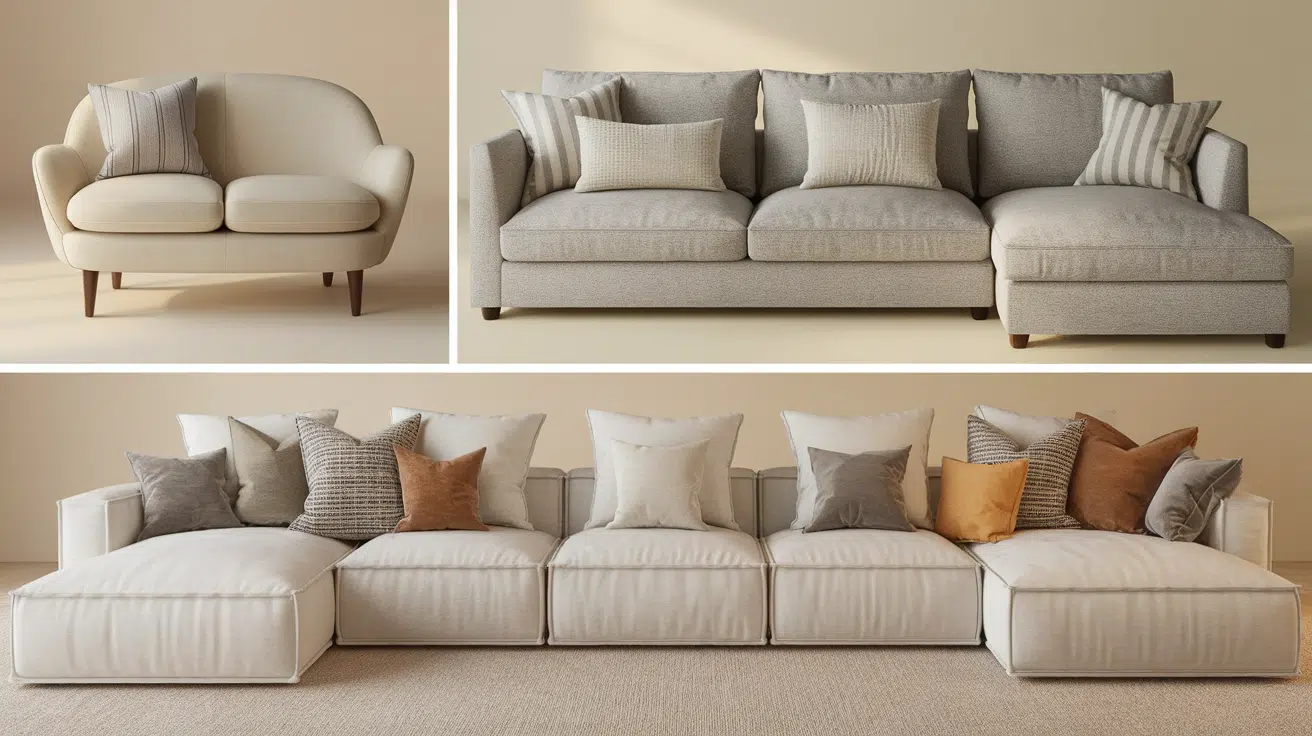
Use two larger pillows, one on each side, or a three-pillow asymmetrical arrangement. Avoid deep layering that consumes the center seat.
The 2-2-1 formula is reliable: two large anchors, two medium coordinating pillows, and one central lumbar or statement pillow.
Increase the anchor size before increasing the number of pillows. Five substantial pillows often look better than seven undersized ones.
The sofa already provides a clean background, so use fewer pillows with deliberate texture or pattern. Keep the top line uncluttered.
Do not make decorative pillows compete with every back cushion. Use one or two accents at the outer corners or center.
Use solids and quiet textures to create visual rest. Pull one or two colors from the upholstery instead of adding another equally dominant pattern.
Build a Cohesive Color and Pattern Mix
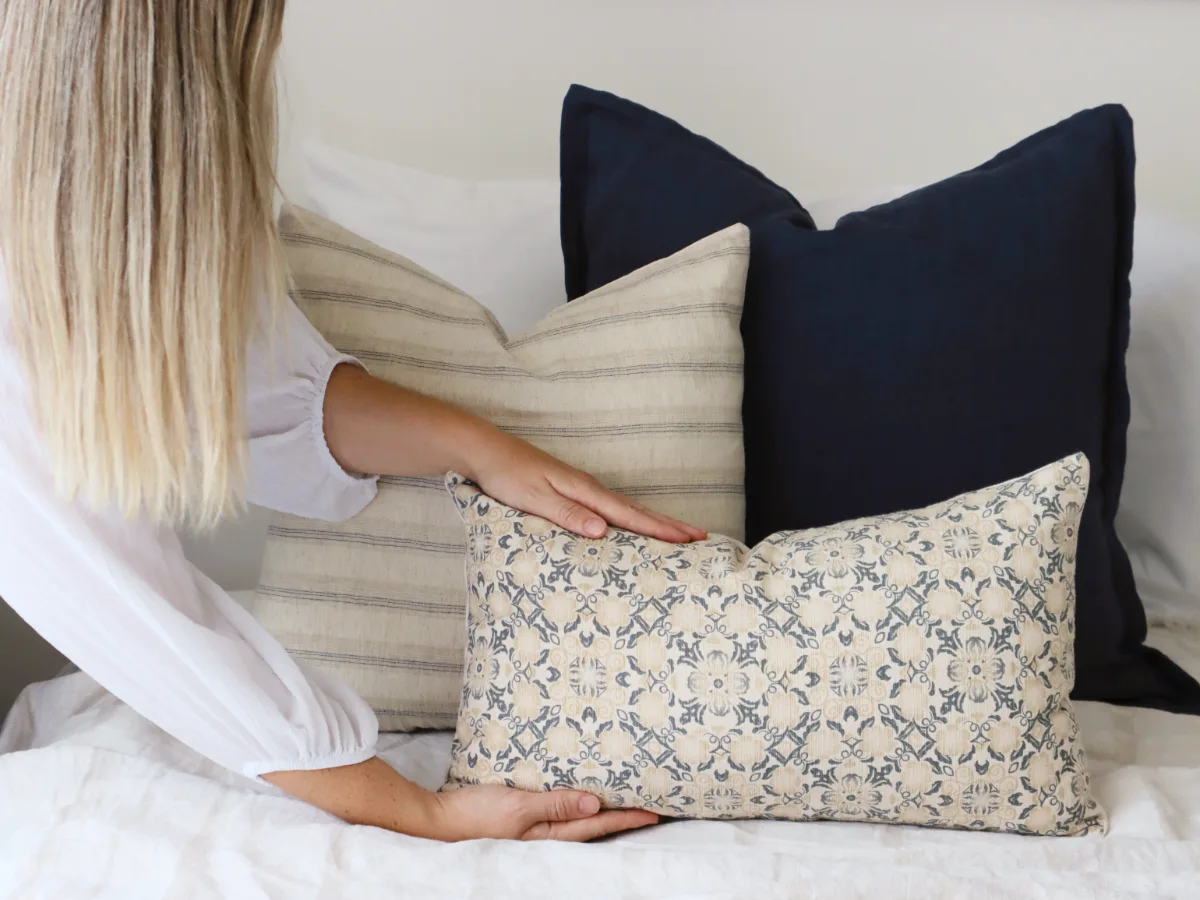
Begin with the room rather than shopping for isolated pillows. Pull colors from fixed or expensive elements first: the sofa, rug, window treatments, wall color, wood tone, and artwork.
A practical palette can use one sofa-adjacent neutral, one repeated room color, one secondary tone, and one smaller accent. Not every pillow needs every color; the arrangement only needs enough repetition to look intentional.
Crate & Barrel suggests balancing patterned sofas with solid pillows so the eye has a quieter place to rest, while its sectional guide recommends taking palette cues from the sofa upholstery. See its throw-pillow styling guide and sectional styling guide.
Mix Texture Without Making the Couch Look Heavy
- Choose one plush texture: Faux fur, shag, heavy boucle, or thick fringe already carries strong visual weight.
- Balance it with flatter fabrics: Linen, cotton, canvas, and smooth velvet can keep the composition from feeling bulky.
- Repeat texture selectively: Two matching velvet anchors may unify the ends of the couch.
- Limit seasonal materials: One or two faux-fur pieces can create warmth; covering the entire sofa may overwhelm the room.
- Match texture to use: A high-contact family couch needs covers that can tolerate regular cleaning and friction.
West Elm recommends limiting faux fur to one or two pillows or a single pillow-and-throw combination so the texture does not overwhelm the room. See West Elm’s faux-fur styling notes.
How to Arrange Throw Pillows on a Sectional
A sectional has more visual zones than a straight sofa. Treat each corner or turn as an anchor point instead of lining pillows evenly across the full length.
- Anchor the outside corner. Place one or two large pillows against the far arm.
- Build the inside corner. Use the deepest corner for a larger cluster because it naturally holds more visual weight.
- Leave the chaise usable. One lumbar or small accent near the back is usually enough.
- Repeat one color across zones. The two clusters do not need to match, but they should share a tone, texture, or pattern family.
- Keep the center open. A sectional should not require guests to remove a wall of pillows before sitting.
Before photographing the finished arrangement, sit down in every major seat. Remove anything that pushes people forward, blocks arm support, or leaves nowhere to place a pillow during normal use.
Style Throw Pillows for Different Room Looks
Modern and minimal
Use two to four pillows, clean shapes, solid colors, restrained contrast, and one texture change. Leave visible negative space around each piece.
Traditional and tailored
Use symmetry, matching outer anchors, repeated piping, classic stripes, checks, florals, or damask-inspired patterns. The 2-2-1 formula works well.
Relaxed and organic
Choose asymmetry, washed linen, soft neutrals, subtle stripes, earthy colors, and one imperfect or hand-crafted texture.
Eclectic or maximalist
Mix more color and pattern but maintain at least one repeating connector, such as a shared blue, black outline, botanical theme, or similar fabric weight.
Seasonal styling
Change covers rather than replacing every insert. Use lighter weaves and cooler contrasts in warm months, then add deeper colors and heavier textures when the room needs more visual warmth.
Common Throw Pillow Arrangement Mistakes
- Using only small pillowsThe arrangement can look scattered and under-scaled. Start with larger anchors and step down.
- Matching every pillow exactlyA complete matching set may look flat. Keep one connector but vary scale, texture, or shape.
- Using several dominant patternsGive one pattern the leading role and let the others support it.
- Ignoring the sofa’s own patternA patterned couch already counts as a major pattern in the room.
- Filling every inch of seatingThe best arrangement still allows people to sit without moving most of the pillows.
- Making both sides equally busyBalance visual weight, not necessarily the exact number and shape of every piece.
- Choosing covers that cannot handle the roomPets, children, sunlight, food, and high use should influence fabric and cleaning requirements.
- Using sleeping pillows as decorative substitutesThrow pillows style a couch; a dedicated sleep pillow is designed for nighttime head and neck support.
Keep the Arrangement Looking Fresh
- Fluff and rotate inserts so one corner does not remain permanently compressed.
- Swap the left and right anchors occasionally to distribute sunlight and wear.
- Vacuum seams and textured fabric as part of normal upholstery care.
- Treat spills promptly and follow the care label for each cover and insert.
- Store seasonal covers clean and completely dry.
- Replace inserts that no longer fill the corners or recover after fluffing.
For cleaning instructions, read How to Wash Throw Pillows in Washing Machine. The guide separates cover care from fill-specific insert care.
Need a Pillow for Sleep Rather Than Sofa Styling?
Throw pillows are designed mainly for decoration and casual support. For nighttime use, choose a pillow intended to support your normal sleeping position and follow the exact product care instructions.
NIGHTTIME SUPPORT
Contour Relief Pillow
View product details, construction, and current care information.
NIGHTTIME SUPPORT
Ultra Contour Relief Pillow
Compare the current model details and care instructions.
Frequently Asked Questions
How many throw pillows should be on a couch?
Three to five often works on a standard sofa, while a loveseat may need only two or three. A large sectional can hold more, but usable seating matters more than reaching a specific number.
What is the 2-2-1 pillow arrangement?
It uses two large matching anchors, two medium coordinating pillows in front, and one smaller statement or lumbar pillow in the center.
Should throw pillows match the couch?
They do not need to match exactly. They should connect to the couch or surrounding room through repeated color, tone, texture, or pattern.
What size throw pillows look best on a couch?
Many standard sofas work with 20- to 22-inch anchors, followed by 18- to 20-inch pillows and one smaller lumbar or round accent. Deep sofas and sectionals may need 22- to 24-inch anchors.
Do throw pillows have to be an odd number?
No. Odd numbers create a relaxed composition, while pairs and symmetry suit tailored or formal rooms. Choose based on the couch and desired mood.
Can I mix square, round, and lumbar pillows?
Yes. One shape change often makes the arrangement more interesting. Too many competing shapes can make a small couch look cluttered.
How do I mix throw pillow patterns?
Use one dominant large-scale pattern, one smaller supporting pattern, and one or more solids or textures. Repeat at least one color across the group.
How should I arrange pillows on a sectional?
Create clusters at the outside arm and inside corner, repeat one color across the zones, keep the chaise lightly styled, and leave the central seating area open.
Should pillow inserts be larger than the covers?
A slightly fuller insert can help a decorative cover look plump, but sizing depends on the cover construction, zipper strength, seam allowance, and desired shape. Do not force an insert that strains the seams.
How often should I change a throw pillow arrangement?
Change it when the room’s use, season, textiles, or color palette changes. Rotating covers and rearranging existing inserts is usually enough to refresh the sofa.
Related Pallas Cozy Guides
Sources and Further Reading
Editorial note: Pillow formulas are starting points, not fixed interior-design rules. Adjust the arrangement to the sofa’s scale, the room’s palette, and how people actually use the seating.
